>
Siluriformes (Catfishes) >
Bagridae (Bagrid catfishes)
Etymology: Bagrus: Mozarabic, bagre, taken from Greek, pagros = a fish (Dentex sp.) (Ref. 45335).
More on author: Lönnberg.
Entorno: milieu / zona climática / rango de profundidad / gama de distribución
Ecología
; agua dulce demersal. Tropical; 4°S - 6°S
Africa: restricted to the single type specimen from the Lubosi River (Luala tributary, lower Congo River basin) (Ref. 78218). Presence in the Lulua (Ref. 46243) unconfirmed and doubtful (Ref. 3236, 78218).
Tamaño / Peso / Edad
Madurez: Lm ? range ? - ? cm
Max length : 24.3 cm SL macho / no sexado; (Ref. 3236)
Descripción breve
Claves de identificación | Morfología | Morfometría
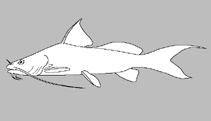
Espinas dorsales (total) : 1; Radios blandos dorsales (total) : 8 - 9; Radios blandos anales: 11. Head smooth above; snout broadly rounded; band of premaxillary teeth 6 times as long as broad, close to and nearly as broad as the crescentic band of vomerine teeth; maxillary barbel 2.25 times head length, reaching beyond pelvic fins; nasal barbel 0.4 times head length; inner mandibulary barbel 0.43 times head length; outer mandibulary barbel 0.86 times head length; occipital processus narrow and short, widely separated from the first interneural bone; longest branched ray of dorsal fin 0.71 times head length; dorsal spine very weak; adipose fin 4 times longer than high, much longer than the base of the dorsal fin; caudal fin deeply forked, both lobes with long filaments; pectoral spine weak with the outer half articulated (Ref. 52141).
Coloration: brown above with irregularly scattered small black dots which are most numerous on the caudal and adipose fin, but are also seen on the back and sides; no dots below lateral line; whitish below (Ref. 52141).
Ciclo vital y comportamiento de apareamiento
Madurez | Reproducción | Puesta | Huevos | Fecundidad | Larva
Risch, L.M., 1986. Bagridae. p. 2-35. In J. Daget, J.-P. Gosse and D.F.E. Thys van den Audenaerde (eds.) Check-list of the freshwater fishes of Africa (CLOFFA). ISNB, Brussels; MRAC, Tervuren; and ORSTOM, Paris. Vol. 2. (Ref. 3236)
Situación en la Lista Roja de la UICN (Ref. 130435: Version 2025-2 (Global))
Amenaza para el ser humano
Harmless
Usos humanos
Herramientas
Informes especiales
Descargar XML
Fuentes de Internet
Estimaciones basadas en modelos
Índice de diversidad filogenética (Referencia
82804): PD
50 = 0.5005 [Uniqueness, from 0.5 = low to 2.0 = high].
Bayesian length-weight: a=0.00871 (0.00415 - 0.01826), b=2.93 (2.76 - 3.10), in cm total length, based on LWR estimates for this (Sub)family-body shape (Ref.
93245).
Nivel trófico (Referencia
69278): 3.7 ±0.9 se; based on size and trophs of closest relatives
Resiliencia (Referencia
120179): Alto, población duplicada en un tiempo mínimo inferior a 15 meses (Assuming Fec>10,000).
Vulnerabilidad pesquera (Ref.
59153): Low vulnerability (20 of 100).
🛈