>
Eupercaria/misc (Various families in series Eupercaria) >
Lutjanidae (Snappers) > Caesioninae
Etymology: Pterocaesio: Greek, pteron = wing, fin + Latin, caesius = blue grey (Ref. 45335).
More on author: Bleeker.
Environnement : milieu / zone climatique / profondeur / gamme de distribution
Écologie
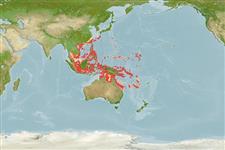
marin récifal; non migrateur; profondeur 0 - 50 m (Ref. 402). Tropical; 30°N - 24°S, 97°E - 171°E (Ref. 402)
Indo-Wes Pacific.
Report from Réunion (Ref. 4517) is probably a misidentification of Pterocaesio marri.
Longueur à la première maturité / Taille / Poids / Âge
Maturité: Lm 21.3 range ? - ? cm
Max length : 30.0 cm TL mâle / non sexé; (Ref. 402)
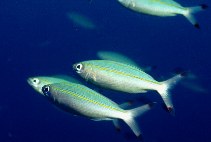
Épines dorsales (Total) : 10; Rayons mous dorsaux (Total) : 14 - 16; Épines anales: 3; Rayons mous anaux: 11 - 12. Body blue to greenish dorsally, white ventrally. With two thin yellow to orange lines; lower line mostly just below lateral line. Black tips on caudal fin (Ref. 48636). 4-5 scales on cheek; 24-31 predorsal scales; scaled dorsal and anal fins. Upper peduncular scale rows usually 12 or 13 (11-14); lower peduncular scale rows usually 16 or 17 (16-18). A broad process on ventrolateral surface of basioccipital for attachment of Baudelot's ligament, extending ventrally beyond a horizontal with condyle's rim, adjacent to condyle. Post maxillary with 2 processes; posterior end of maxilla tapered (Ref. 1723). Head length 3.0-3.5 in SL; body depth 3.5-4.1 in SL (Ref. 90102).
Body shape (shape guide): fusiform / normal; Cross section: compressed.
Found in coastal areas, primarily around coral reefs (Ref. 402), turning bright red (Ref. 48636). Feed on zooplankton in midwater aggregations (Ref. 402). Oviparous, with numerous, small pelagic eggs (Ref. 402).
Cycle de vie et comportement reproducteur
Maturité | Reproduction | Frai | Œufs | Fécondité | Larves
Mating behavior observed from an aquarium include six distinguishable patterns: 1) up and down swimming; 2) courtship; 3) rushing; 4) pair spawning; 5) sperm release by sneakers; and 6) post spawning (Ref. 37529).
At nearly sunset, the usual quiet pack of fish give way to spawners swimming at the surface. A male selects a female and initiates pecking and pushing of the female's abdomen with his snout. At the rushing stage, the male pushed the female forward, and the couple began to swim in a semicircle in short bursts while other 10-15 sneakers within the school joined in. The initial couple then released eggs and sperm at the surface with their abdomens facing one another. Some of the leading sneakers may also release sperm at the same spot where the initial couple spawned. After spawning, the pair with the sneakers return to the school (Ref. 37529).
Carpenter, K.E., 1987. Revision of the Indo-Pacific fish family Caesionidae (Lutjanoidea), with descriptions of five new species. Indo-Pac. Fish. (15):56 p. (Ref. 1723)
Statut dans la liste rouge de l'IUCN (Ref. 130435: Version 2025-2 (Global))
Menace pour l'homme
Harmless
Utilisations par l'homme
Pêcheries: commercial
Outils
Articles particuliers
Télécharger en XML
Sources Internet
Estimations basées sur des modèles
Température préférée (Réf.
123201): 24.7 - 29, mean 28 °C (based on 702 cells).
Indice de diversité phylogénétique (Réf.
82804): PD
50 = 0.5002 [Uniqueness, from 0.5 = low to 2.0 = high].
Bayesian length-weight: a=0.01000 (0.00566 - 0.01766), b=3.14 (2.99 - 3.29), in cm total length, based on LWR estimates for this species & Genus-body shape (Ref.
93245).
Niveau trophique (Réf.
69278): 3.4 ±0.48 se; based on food items.
Résilience (Réf.
120179): Milieu, temps minimum de doublement de population : 1,4 à 4,4 années (tm=2-3).
Vulnérabilité de la pêche (Ref.
59153): Low vulnerability (20 of 100).
🛈
Nutriments (Ref.
124155): Calcium = 55.6 [35.8, 81.2] mg/100g; Iron = 0.675 [0.441, 0.997] mg/100g; Protein = 18.8 [17.8, 19.7] %; Omega3 = 0.14 [0.10, 0.20] g/100g; Selenium = 28.6 [17.5, 48.8] μg/100g; VitaminA = 147 [57, 378] μg/100g; Zinc = 1.25 [0.91, 1.66] mg/100g (wet weight);