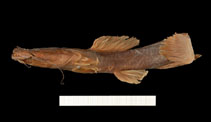
>
Siluriformes (Catfishes) >
Auchenoglanididae (Flatnose catfishes)
Etymology: Notoglanidium: Greek, noton = back + Greek, glanis = a fish that can eat the bait without touching the hook; a cat fish; diminutive (Ref. 45335); boutchangai: Named in honour of H. Boutchanga, collector of the type specimens (Ref. 94168).
Eponymy: Honoré Boutchanga was a Gabonese technical assistant, Eaux et Forêts (Waters and Forests). He collected the holotype. (Ref. 128868), visit book page.
Environnement : milieu / zone climatique / profondeur / gamme de distribution
Écologie
; eau douce démersal. Tropical
Africa: Louetsi River or Ngounié River in southern Gabon (Ref. 94168).
Taille / Poids / Âge
Maturité: Lm ? range ? - ? cm
Max length : 19.8 cm SL mâle / non sexé; (Ref. 94168)
Épines dorsales (Total) : 2; Rayons mous dorsaux (Total) : 7; Épines anales: 0; Rayons mous anaux: 14 - 17; Vertèbres: 40. Diagnosis: combined premaxillary tooth plate width rather large, 30.1-35.3% of head length vs. larger in N. macrostoma and smaller in N. akiri, N. pembetadi and much smaller in the other species except N. depierrei; interorbital distance small, 17.2-23.4% of head length vs. larger in N. akiri and over 27% in N. macrostoma, M. maculatum, N. thomasi and N. walkeri; eye diameter relatively large, 7.5-10.4% of head length, negatively allometric with body size, vs. smaller in N. pallidum and N. maculatum; only 7 soft dorsal-fin rays vs. more than 8 in N. depierrei, N. maculatum, N. pallidum, N. pembetadi, N. thomasi and N. walkeri (Ref. 94168).
Body shape (shape guide): elongated.
Inhabits rivers (Ref. 27938).
Cycle de vie et comportement reproducteur
Maturité | Reproduction | Frai | Œufs | Fécondité | Larves
Geerinckx, T., E. Vreven, M. Dierick, L.V. Hoorebeke and D. Adriaens, 2013. Revision of Notoglanidium and related genera (Siluriformes: Claroteidae) based on morphology and osteology. Zootaxa 3691(1):165-191. (Ref. 94168)
Statut dans la liste rouge de l'IUCN (Ref. 130435: Version 2025-2 (Global))
Menace pour l'homme
Harmless
Utilisations par l'homme
Outils
Articles particuliers
Télécharger en XML
Sources Internet
Estimations basées sur des modèles
Indice de diversité phylogénétique (Réf.
82804): PD
50 = 0.5020 [Uniqueness, from 0.5 = low to 2.0 = high].
Bayesian length-weight: a=0.00525 (0.00219 - 0.01260), b=3.09 (2.87 - 3.31), in cm total length, based on LWR estimates for this (Sub)family-body shape (Ref.
93245).
Niveau trophique (Réf.
69278): 3.5 ±0.6 se; based on size and trophs of closest relatives
Résilience (Réf.
120179): Haut, temps minimum de doublement de population inférieur à 15 mois (Preliminary K or Fecundity.).
Vulnérabilité de la pêche (Ref.
59153): Low vulnerability (14 of 100).
🛈