Miljö: miljö / Klimatzon / djupintervall / distributionsområde
Ekologi
; sötvatten bottenlevande; djupintervall ? - 20 m (Ref. 3236). Tropical; 3°S - 9°S
Africa: Lake Tanganyika.
Storlek / Vikt / Ålder
Könsmognad: Lm ? range ? - ? cm
Max length : 8.8 cm TL hane/ej könsbestämd; (Ref. 3236)
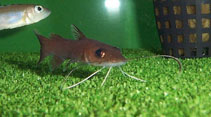
Inhabit inshore waters to 20 m deep (Ref. 3236), and restricted to the rocky littoral zone (Ref. 38677). Rest on the bottom with the modified maxillary barbels (Ref. 6868). Nocturnally active meanwhile resting beneath rocks and within interstices in the rock or rubble substrata during the day (Ref. 38677). Oviparous (Ref. 205). First report of bi-parental mouthbrooding among catfishes (Ref. 38677). No value as food (Ref. 4967). Stomach contents examined consist of shrimps, occasionally debris from larval insects, and fish remains which apparently are clupeids (possibly Limnothrissa. Aquarium conditions: pH7.6; hardness of water 12; temperature tolerance 25°C; tank capacity, 60L; food, e.g. live worms, Daphnia; aquarium lighting, as dark as possible as long as fishes are visible; a peaceful, bottom-swimming fish which prefers a set-up with rocks, plants, and driftwood in an aquarium (Ref. 6398).
Livscykel och parningsbeteende
Könsmognad | Reproduktion | Lek | Ägg | Fekunditet | Larver
First report of biparental mouthbrooding among catfishes (Ref. 38677). Either or both parents rear their eggs and yolk-sac larvae inside the mouth (Ref. 38677). Young are released from the mouth after the yolk-sac has been absorbed and kept guarded by both parents while feeding beneath rocks (Ref. 38677). After feeding, young return to the parent's mouth (Ref. 38677). No evidence of brooding was found among solitary individuals, additionally, females in this group have low gonadosomatic index (Ig) indicating that a strong bonding of pairs precede egg laying (Ref. 38677).
Risch, L.M., 1986. Bagridae. p. 2-35. In J. Daget, J.-P. Gosse and D.F.E. Thys van den Audenaerde (eds.) Check-list of the freshwater fishes of Africa (CLOFFA). ISNB, Brussels; MRAC, Tervuren; and ORSTOM, Paris. Vol. 2. (Ref. 3236)
Status på IUCN:s rödlista (Ref. 130435: Version 2025-2 (Global))
Hot mot människor
Harmless
Mänskliga användningsområden
Fiskeri: av potentiellt intresse; Akvarium: Potentiell
Verktyg
Särskilda rapporter
Ladda ner XML
Internet-källor
Uppskattningar baserade på modeller
Index för fylogenetisk mångfald (Ref.
82804): PD
50 = 0.6250 [Uniqueness, from 0.5 = low to 2.0 = high].
Bayesian length-weight: a=0.00912 (0.00416 - 0.02000), b=3.00 (2.81 - 3.19), in cm total length, based on LWR estimates for this (Sub)family-body shape (Ref.
93245).
Trofisk nivå (Ref.
69278): 4.0 ±0.70 se; based on food items.
Resiliens (Ref.
120179): Hög, lägsta populationsfördubblingstid mindre än 15 månader (Preliminary K or Fecundity.).
Sårbarhet i fisket (Ref.
59153): Low vulnerability (10 of 100).
🛈