>
Siluriformes (Catfishes) >
Schilbeidae (Schilbid catfishes)
Etymology: Pareutropius: Greek, par = beside, near + Greek, eu = well + Greek, tropis = keel, in reference to the compressed body of the fish; mandevillei: Named for Mr. J. Th. Mandeville, citizen of Leopoldville and collector of part of the type specimens of this species (Ref. 43912).
Eponymy: J Th Mandeville was the fisheries agent for the government of Leopoldville, Congo (Kinshasa, DRC). He collected some of the type and paratype specimens. (Ref. 128868), visit book page.
More on author: Poll.
Umwelt: Milieu / Klimazone / Tiefenbereich / Verbreitungsgebiet
Ökologie
; süßwasser demersal. Tropical; 3°N - 10°S
Africa: Congo River basin including Pool Malebo (= Stanley Pool) and Lake Mweru, but not the Zambian Congo (Ref. 78218).
Größe / Gewicht / Alter
Geschlechtsreife: Lm ? range ? - ? cm
Max length : 6.5 cm SL Männchen/unbestimmt; (Ref. 43912)
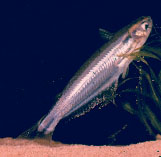
Rückenflossenstacheln (insgesamt) : 1; Afterflossenstacheln: 0. Diagnosis: two pairs of mandibular barbels; dorsal fin with a spine and 35 soft branched rays; pectoral with 7-8 branched rays; 7-8 branchiostegal rays on one side of head; 31-46 branched anal fin rays; dark mid-dorsal line continuing on upper half of caudal fin, sometimes somewhat bent downwards near posterior border of that fin; dark lateral line streak continues straight over caudal peducle and bends downwards slightly on caudal fin (Ref. 43912).
Feeds at least partly on insects and their larvae (Ref. 43912). Oviparous, eggs are unguarded (Ref. 205). Maximum reported total length 7.5 cm (Ref. 43912).
Lebenszyklus und Paarungsverhalten
Geschlechtsreife | Fortpflanzung | Ablaichen | Eier | Fruchtbarkeit | Larven
Distinct pairing (Ref. 205).
De Vos, L., 1995. Results of a systematic revision of African schilbeids at the species level. p.113-364. In L. De Vos. A systematic revision of the African Schilbeidae (Teleostei, Siluriformes) with an annotated bibliography, Chapter 3. Ann. Mus. R. Afr. Centr. Zool. vol. 271. (Ref. 33556)
IUCN Rote Liste Status (Ref. 130435: Version 2025-2 (Global))
Bedrohung für Menschen
Harmless
Nutzung durch Menschen
Tools
Zusatzinformationen
Download XML
Internet Quellen
Schätzungen auf der Grundlage von Modellen
Phylogenetischer Diversitätsindex (Ref.
82804): PD
50 = 0.5625 [Uniqueness, from 0.5 = low to 2.0 = high].
Bayesian length-weight: a=0.00550 (0.00251 - 0.01205), b=3.06 (2.87 - 3.25), in cm total length, based on LWR estimates for this (Sub)family-body shape (Ref.
93245).
Trophische Ebene (Ref.
69278): 3.2 ±0.5 se; based on size and trophs of closest relatives
Widerstandsfähigkeit (Ref.
120179): niedrig, Verdopplung der Population dauert 4,5 - 14 Jahre. (Assuming fec < 100).
Anfälligkeit der Fischerei (Ref.
59153): Low vulnerability (10 of 100).
🛈