>
Siluriformes (Catfishes) >
Schilbeidae (Schilbid catfishes)
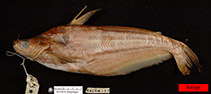
Etymology: multitaeniatus: From the Latin "multus" (many, much) and "taenia" (band) referring to the lateral stripes on the sides and along the anal fin (Ref. 43912).
More on author: Pellegrin.
Environnement : milieu / zone climatique / profondeur / gamme de distribution
Écologie
; eau douce démersal. Tropical
Africa: basins of the Nyong, Ntem (Ref. 43912, 81643), Ogooué and Dja (Ref. 43912) in Cameroon; the Ogooué, Nyanga, N'dogo (Ref. 43912, 81643), Nkomi and Ntem basins (Ref. 81643) in Gabon; and the basins of the Kouilou (Ref. 43912, 81643) and upper Ogooué (Ref. 43912) in Republic of Congo.
Taille / Poids / Âge
Maturité: Lm ? range ? - ? cm
Max length : 26.3 cm SL mâle / non sexé; (Ref. 43912)
Épines dorsales (Total) : 1. Diagnosis: adipose fin present (Ref. 43912, 81643) and fully developed (Ref. 81643). Posterior nostrils as close as (Ref. 81643) or closer to each other than are the anterior pair (Ref. 43912, 81643). Inner side of pectoral fin spine weakly serrated (Ref. 43912, 81643). Barbels well developed, nasal barbel always reaching beyond posterior eye border (Ref. 43912, 81643) and often beyond anterior border of opercle (Ref. 81643). Medium-sized species, growing over 25 cm SL with distinct lateral bands on body, predominantly with several dark lateral streaks and/or irregular marbling (Ref. 81643). Lower jaw reaching as far as snout or only a little shorter than upper jaw (Ref. 43912, 81643), never completely surrounded by the upper lips when mouth is closed (Ref. 43912). Interorbital width 54.6-68.2% HL; mouth width 48.7-63% HL (Ref. 81643). 45-60 branched anal fin rays (Ref. 43912, 81643).
Body shape (shape guide): fusiform / normal; Cross section: compressed.
Oviparous, eggs are unguarded (Ref. 205). Locally this species might have some value for the fishermen (Ref. 43912).
Cycle de vie et comportement reproducteur
Maturité | Reproduction | Frai | Œufs | Fécondité | Larves
Distinct pairing (Ref. 205).
De Vos, L., 1986. Schilbeidae. p. 36-53. In J. Daget, J.-P. Gosse and D.F.E. Thys van den Audenaerde (eds.) Check-list of the freshwater fishes of Africa (CLOFFA). ISNB, Brussels; MRAC, Tervuren; and ORSTOM, Paris. Vol. 2. (Ref. 3570)
Statut dans la liste rouge de l'IUCN (Ref. 130435: Version 2025-2 (Global))
Menace pour l'homme
Harmless
Utilisations par l'homme
Outils
Articles particuliers
Télécharger en XML
Sources Internet
Estimations basées sur des modèles
Indice de diversité phylogénétique (Réf.
82804): PD
50 = 0.5000 [Uniqueness, from 0.5 = low to 2.0 = high].
Bayesian length-weight: a=0.00550 (0.00251 - 0.01205), b=3.06 (2.87 - 3.25), in cm total length, based on LWR estimates for this (Sub)family-body shape (Ref.
93245).
Niveau trophique (Réf.
69278): 3.4 ±0.5 se; based on size and trophs of closest relatives
Résilience (Réf.
120179): Haut, temps minimum de doublement de population inférieur à 15 mois (Assuming fec > 10,000).
Vulnérabilité de la pêche (Ref.
59153): Low vulnerability (22 of 100).
🛈