>
Siluriformes (Catfishes) >
Schilbeidae (Schilbid catfishes)
Etymology: yangambianus: Referring to the type locality of this species, Yangambi (Middle Congo)(Ref. 43912).
More on author: Poll.
Environnement : milieu / zone climatique / profondeur / gamme de distribution
Écologie
; eau douce démersal. Tropical
Africa: middle Congo River basin including the drainages of the Ubangi, Kasai and Kwando (Ref. 43912) and Lukenie basin (Ref. 127185); also known from a single locality on the upper Zambezi river in Zambia (Ref. 43912). Also reported from the upper Congo (Ref. 106245) and the Zambezi in Angola (Ref. 120641).
Taille / Poids / Âge
Maturité: Lm ? range ? - ? cm
Max length : 25.0 cm SL mâle / non sexé; (Ref. 3570)
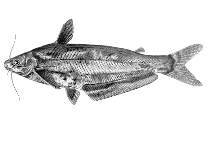
Épines anales: 0. Diagnosis: adipose fin always present; anterior nostrils closer to each other or at same distance as posterior ones; barbels well developed, nasal barbel at least reaching to anterior border of opercle; snout reaching beyond lower jaw, upper lips slightly surrounding lower jaw when mouth is closed; inner side of pectoral spine feebly serrated; striking brownish colour pattern, often irregularly marbled and characterized by the presence of a very dark blotch above pectoral spine, where swim-bladder lies close below skin; eyes rather small (Ref. 43912).
Prefer smaller forest streams with rocky (Ref. 7248, 43912) or sandy bottom (Ref. 43912). Nocturnal (Ref. 43912). Probably carnivorous (Ref. 43912), with a preference for terrestrial and aquatic insects (Ref. 7248, 43912). Oviparous, eggs are unguarded (Ref. 205).
Cycle de vie et comportement reproducteur
Maturité | Reproduction | Frai | Œufs | Fécondité | Larves
Distinct pairing (Ref. 205).
Skelton, P.H., 1993. A complete guide to the freshwater fishes of southern Africa. Southern Book Publishers. 388 p. (Ref. 7248)
Statut dans la liste rouge de l'IUCN (Ref. 130435: Version 2025-2 (Global))
Menace pour l'homme
Harmless
Utilisations par l'homme
Outils
Articles particuliers
Télécharger en XML
Sources Internet
Estimations basées sur des modèles
Indice de diversité phylogénétique (Réf.
82804): PD
50 = 0.5000 [Uniqueness, from 0.5 = low to 2.0 = high].
Bayesian length-weight: a=0.00550 (0.00251 - 0.01205), b=3.06 (2.87 - 3.25), in cm total length, based on LWR estimates for this (Sub)family-body shape (Ref.
93245).
Niveau trophique (Réf.
69278): 2.9 ±0.45 se; based on food items.
Résilience (Réf.
120179): Haut, temps minimum de doublement de population inférieur à 15 mois (Assuming fec > 10,000).
Vulnérabilité de la pêche (Ref.
59153): Low vulnerability (21 of 100).
🛈