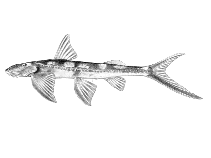
Ambiente: milieu / zona climatica / distribuzione batimetrica / gamma di distribuzione
Ecologia
; acqua dolce demersale. Tropical; 3°N - 10°S, 14°E - 30°E
Africa: present throughout the Congo River basin (Ref. 78218). In the Lukuga (Tanganyika outflow) up to the Kisimba-Kilia rapids (Ref. 93587). Reports of this species from Inga and the Luongo River (Zambian Congo) refer to Congoglanis inga and C. sagitta, respectively (Ref. 88958). Reports from the Luachimo River (Ref. 11970) are C. howesi (Ref. 92838).
Dimensione / Peso / Età
Maturità: Lm ? range ? - ? cm
Max length : 14.1 cm SL maschio/sesso non determinato; (Ref. 88958)
Breve descrizione
Chiavi di identificazione | Morfologia | Morfometria
Spine dorsali (totale) : 0; Raggi dorsali molli (totale) : 8; Spine anali: 0; Raggi anali molli: 9 - 11. Diagnosis: Congoglanis alula differs from C. inga in having a shorter maxillary barbel not reaching to vertical through anterior margin of orbit, vs. extending well past anterior margin of orbit, respectively; a longer pelvic fin, 24–28% of standard length, vs. 19–21%; a shorter postorbital length, 27–31% of head length, vs. 32–35%; a relatively narrow interorbital width, 1.5 times eye diameter, vs. 2 times; and shorter anal-fin rays, posterior rays of adpressed anal fin extend to, rarely slightly beyond, vertical through posterior limit of adipose fin, vs. posterior rays extend well past vertical through posterior limit of adipose fin (Ref. 88958). Congoglanis alula differs from C. sagitta in having a longer pectoral fin, 28–29% of standard length, vs. 23–27%; a longer pelvic fin, 24–28% of standard length, vs. 19–21%; a shorter caudal peduncle, 18–22% of standard length, vs. 21–24%; and deeper caudal peduncle, caudal-peduncle depth 2.6–3.3 times in caudal-peduncle length, vs. 3.1–4.0 times; a relatively narrow interorbital width, 1.5 times eye diameter, vs. 2 times; a more posteriorly placed anal fin, anal-fin origin approximately at tip of adpressed pelvic fin, vs. origin well in advance of tip of adpressed pelvic fin; and fewer vertebrae, 36–39, vs. 39–41 (Ref. 88958).
Body shape (shape guide): elongated.
Typically found in fastest flowing portions of rivers and always associated with large rocks; appears to congregate underneath rocks near where water breaks over the rocks during the day, and will move out onto the tops of rocks at night (Ref. 88958).
Ciclo vitale e comportamento di accoppiamento
Maturità | Riproduzione | Deposizione | Uova | Fecondità | Larve
Ferraris, C.J. Jr., R.P. Vari and P.H. Skelton, 2011. A new genus of African loach catfish (Siluriformes: Amphiliidae) from the Congo River basin, the sister-group to all other genera of the Doumeinae, with the description of two new species. Copeia 2011(4):477-489. (Ref. 88958)
Stato della Lista Rossa IUCN (Ref. 130435: Version 2025-2 (Global))
Minaccia per l'uomo
Harmless
Usi umani
Strumenti
Rapporti speciali
Scarica XML
Fonti Internet
Stime basate su modelli
Indice di diversità filogenetica (Fonte Biblio.
82804): PD
50 = 0.5625 [Uniqueness, from 0.5 = low to 2.0 = high].
Bayesian length-weight: a=0.00389 (0.00180 - 0.00842), b=3.12 (2.94 - 3.30), in cm total length, based on all LWR estimates for this body shape (Ref.
93245).
Livello trofico (Fonte Biblio.
69278): 3.1 ±0.4 se; based on size and trophs of closest relatives
Resilienza (Fonte Biblio.
120179): Medio, tempo minimo di raddoppiamento della popolazione 1.4 - 4.4 anni (Preliminary K or Fecundity.).
Vulnerabilità della pesca (Ref.
59153): Low vulnerability (10 of 100).
🛈