>
Scombriformes (Mackerels) >
Scombridae (Mackerels, tunas, bonitos) > Scombrinae
Etymology: Cybiosarda: Greek, kybion = tunna + Latin, sarda = sardine (Ref. 45335).
More on author: Whitley.
Environnement : milieu / zone climatique / profondeur / gamme de distribution
Écologie
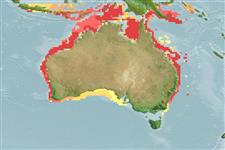
marin pelagic-neritic; océanodrome (Ref. 51243); profondeur 50 - ? m. Tropical; 6°S - 41°S, 108°E - 158°E (Ref. 168)
Western Pacific: restricted to the northern three quarters of Australia (absent from the south coast) and the southern coast of Papua New Guinea.
Taille / Poids / Âge
Maturité: Lm ? range ? - ? cm
Max length : 45.0 cm FL mâle / non sexé; (Ref. 168); common length : 35.0 cm FL mâle / non sexé; (Ref. 168); poids max. publié: 2.0 kg (Ref. 168)
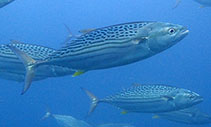
Épines dorsales (Total) : 16 - 18; Rayons mous dorsaux (Total) : 17 - 19; Épines anales: 0; Rayons mous anaux: 15 - 17; Vertèbres: 47 - 48. This species is distinguished by the following characters: body moderately short and deep, strongly compressed; mouth moderately large with upper jaw reaching to hind margin of eye; 2 tooth patches on upper surface of tongue; 13-22 large, conical teeth on upper jaw, 10-17 on lower jaw; 12-15 total gill rakers on first gill arch; l28-33 laminae of olfactory rosette; interorbital width 23.9 to 31% of head length; D1 XVI-XVIII,17-19, dorsal fins close together, the first high anteriorly, soft rays followed by 8-10 finlets; A 15-17 followed by 6-7 finlets; pectoral fins short with 22-24 rays; interpelvic process small and bifid; body mostly naked behind the well-developed corselet except for a band of scales along bases of dorsal and anal fins and patches of scales around bases of the pectoral and pelvic fins; caudal peduncle slender, with a well-developed lateral keel between 2 smaller keels on each side; no swimbladder, spleen not visible in ventral view, concealed under liver; liver with an elongate right lobe and a short left lobe which tends to fuse with the middle lobe; vertebrae 22-24 + 23-26 = 47-48. Colour of belly light with several stripes reminiscent of those of the skipjack tuna, Katsuwonus pelamis; back deep blue covered with elongate black spots; first dorsal fin jet black anteriorly, white in the few last posterior membranes; anal and second dorsal fins yellow (Ref. 9684).
Body shape (shape guide): fusiform / normal; Cross section: compressed.
An epipelagic, neritic species that forms schools of several hundred individuals. Taken as bait for snappers by commercial fishers, and for marlins and sharks by sport fishers. Its meat is white and dry and is good when smoked or served steamed with moderately flavored white sauce.
Cycle de vie et comportement reproducteur
Maturité | Reproduction | Frai | Œufs | Fécondité | Larves
Collette, B.B. and C.E. Nauen, 1983. FAO Species Catalogue. Vol. 2. Scombrids of the world. An annotated and illustrated catalogue of tunas, mackerels, bonitos and related species known to date. Rome: FAO. FAO Fish. Synop. 125(2):137 p. (Ref. 168)
Statut dans la liste rouge de l'IUCN (Ref. 130435: Version 2025-2 (Global))
Menace pour l'homme
Harmless
Utilisations par l'homme
Pêcheries: intérêt commercial mineur; pêche sportive: oui; appât: usually
Outils
Articles particuliers
Télécharger en XML
Sources Internet
Estimations basées sur des modèles
Température préférée (Réf.
123201): 20.7 - 27.6, mean 26 °C (based on 165 cells).
Indice de diversité phylogénétique (Réf.
82804): PD
50 = 1.0000 [Uniqueness, from 0.5 = low to 2.0 = high].
Bayesian length-weight: a=0.00955 (0.00458 - 0.01993), b=3.06 (2.89 - 3.23), in cm total length, based on LWR estimates for this (Sub)family-body shape (Ref.
93245).
Niveau trophique (Réf.
69278): 4.0 ±0.7 se; based on size and trophs of closest relatives
Résilience (Réf.
120179): Haut, temps minimum de doublement de population inférieur à 15 mois (Preliminary K or Fecundity.).
Vulnérabilité de la pêche (Ref.
59153): Moderate vulnerability (40 of 100).
🛈
Nutriments (Ref.
124155): Calcium = 110 [58, 229] mg/100g; Iron = 1.89 [1.12, 3.14] mg/100g; Protein = 21 [20, 22] %; Omega3 = 0.332 [0.202, 0.541] g/100g; Selenium = 61.7 [31.4, 123.1] μg/100g; VitaminA = 29.8 [12.3, 77.0] μg/100g; Zinc = 0.916 [0.633, 1.352] mg/100g (wet weight);