>
Siluriformes (Catfishes) >
Mochokidae (Squeakers or upside-down catfishes) > Mochokinae
Etymology: Synodontis: Greek, syn, symphysis = grown together + Greek, odous = teeth (Ref. 45335).
More on author: Linnaeus.
Milieu: milieu / Klimaatzone / Diepte / verspreidingsgebied
Ecologie
; zoet water benthopelagisch; pH range: 6.5 - 7.5; dH range: ? - 18; potamodroom (Ref. 51243). Tropical; 21°C - 24°C (Ref. 2060); 35°N - 4°N
Africa: basins of the Senegal, Gambia, Volta, Niger (including the Benue) and Chad (Ref. 57223). Also in the Nile (Ref. 3202).
Grootte / Gewicht / Leeftijd
Maturiteit: Lm ? range ? - ? cm
Max length : 36.0 cm SL mannelijk / geslacht onbekend; (Ref. 31256)
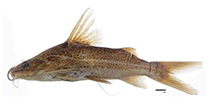
Dorsale stekels (totaal) : 1; Anale stekels: 0. Diagnosis: gill slits not extending ventrally beyond pectoral-fin insertions; snout at most 50% of head length and at most 80% of head width; post-ocular length at least 30% of head length; maxillary barbels shorter than head, bearing externally rather long and more or less tuberculate ramifications and a short, but distinct, basal membrane; outer and inner mandibular barbels with long, simple and finely tuberculate branches; mandibular teeth long, numbering 6-10; pectoral-fin spines more strongly denticulate on inner than on outer margin; dorsal-fin spine denticulate on lower half of anterior margin; humeral process triangular and deep, short and granulose, but not keeled ventrally; adipose fin very well developed and rather close (in large individuals contiguous) to rayed dorsal fin (Ref. 57223).
Coloration: ground colour greyish-brown, ventral areas lighter; caudal fin red, at least in live specimens; young individuals with fine specks scattered over dorsal body region and fins (Ref. 57223).
Body shape (shape guide): fusiform / normal.
Omnivore, feeds on insect larvae, mollusks and detritus (Ref. 13868). Oviparous (Ref. 205). Maximum size 325mm TL, 230mm SL (Ref. 57223).
Levenscyclus en paargedrag
Maturiteit | Voortplanting | Paaien | Eieren | Fecunditeit | Larven
Oviparous (Ref. 205). Distinct pairing during breeding (Ref. 205).
Paugy, D. and T.R. Roberts, 2003. Mochokidae. p. 195-268 In C. Lévêque, D. Paugy and G.G. Teugels (eds.) Faune des poissons d'eaux douce et saumâtres de l'Afrique de l'Ouest, Tome 2. Coll. Faune et Flore tropicales 40. Musée Royal de l'Afrique Centrale, Tervuren, Belgique, Museum National d'Histoire Naturalle, Paris, France and Institut de Recherche pour le Développement, Paris, France. 815 p. (Ref. 57223)
Status op de Rode Lijst van het IUCN (Ref. 130435: Version 2025-2 (Global))
Gevaar voor de mens
Harmless
Gebruik door de mens
Tools
Speciale rapporten
Download XML
Internetbronnen
Schattingen op basis van modellen
Fylogenetische diversiteitsindex (Ref.
82804): PD
50 = 0.5000 [Uniqueness, from 0.5 = low to 2.0 = high].
Bayesian length-weight: a=0.00912 (0.00538 - 0.01546), b=3.09 (2.95 - 3.23), in cm total length, based on LWR estimates for this species & Genus-body shape (Ref.
93245).
Trofisch niveau (Ref.
69278): 3.0 ±0.36 se; based on food items.
Weerstandsvermogen (Ref.
120179): Gemiddeld, minimale populatieverdubbelingstijd 1,4-4,4 jaar (Preliminary K or Fecundity.).
Kwetsbaarheid van de visserij (Ref.
59153): Low to moderate vulnerability (34 of 100).
🛈