>
Siluriformes (Catfishes) >
Mochokidae (Squeakers or upside-down catfishes) > Mochokinae
Etymology: Synodontis: Greek, syn, symphysis = grown together + Greek, odous = teeth (Ref. 45335).
More on author: Boulenger.
Lingkungan: lingkungan / zona iklim / kisaran kedalaman / jangkauan distribusi
Ekologi
; air tawar bentopelagis; pH range: 6.2 - 7.5; dH range: ? - 15. Tropical; 22°C - 26°C (Ref. 1672); 17°N - 4°N
Africa: White Nile (Ref. 3202, 28714), Niger, Volta, Chad, Kwa Ibo (Ref. 57223) and Cross basins (Ref. 52861).
Ukuran / Berat / umur
Kematangan: Lm ? range ? - ? cm
Max length : 30.0 cm SL jantan/; (Ref. 31256)
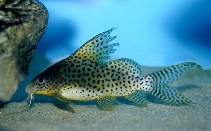
Duri punggung (Keseluruhan (total)) : 1; Duri dubur: 0. Diagnosis: gill slits not extending ventrally beyond pectoral-fin insertions; eye large, its diameter 23-34.5% of head length and 48-75% of snout length; post-orbital length at least 60% of snout length; maxillary barbels unbranched, longer than head, without tubercles and bordered by a rather broad basal membrane restricted to their anterior thirds; outer mandibular barbels with simple, thin and rather long ramifications; branches of inner mandibular barbels shorter, subdivided and tuberculate; mandibular teeth slender and moderately long, numbering 39-62 (62 in the holotype); denticulations of pectoral-fin spines weak on outer margin and well developed on inner margin; dorsal-fin spine smooth anteriorly, except for a few apical denticles; humeral process triangular and not keeled ventrally; adipose fin well developed and rather close to rayed dorsal fin; branched dorsal-fin rays as well as dorsal- and pectoral-fin spines prolonged into filaments; spots present on body and fins (Ref. 57223).
Coloration: body more or less dark brown. Back, sides, head and fins with few isolated small spots; depending on individuals, spots on fins more or less aligned in series; maxillary barbels (including membranes) black; fin filaments darker than fins themselves (Ref. 57223).
Body shape (shape guide): fusiform / normal.
Maximum TL was recorded at 22.2 cm, max. SL at 22.2 cm (Ref. 57223). Occurs over a muddy bottom but may also be found over rocks. Feeds mainly on insect larvae but will also take algae (Ref. 6868). This is also an upside-down species (Ref. 4537). Oviparous (Ref. 205).
Siklus hidup dan perilaku kawin
Kematangan | Reproduksi, perkembang biakan | Pemijahan | telur-telur | Fekunditas | Larva
Oviparous (Ref. 205). Distinct pairing during breeding (Ref. 205).
Gosse, J.-P., 1986. Mochokidae. p. 105-152. In J. Daget, J.-P. Gosse and D.F.E. Thys van den Audenaerde (eds.) Check-list of the freshwater fishes of Africa (CLOFFA). ISNB, Brussels, MRAC, Tervuren; and ORSTOM, Paris. Vol. 2. (Ref. 3202)
Status IUCN Red List (Ref. 130435: Version 2025-2 (Global))
ancaman kepada manusia
Harmless
penggunaan manusia
Perikanan: tidak ada kepentingan; Akuarium: Komersial
Alat, peralatan
laporan khas
muat turun XML
Sumber internet
Estimasi berdasarkan model
Indeks keanekaragaman filogenetik (Acuan
82804): PD
50 = 0.5000 [Uniqueness, from 0.5 = low to 2.0 = high].
Bayesian length-weight: a=0.01445 (0.00659 - 0.03170), b=2.90 (2.72 - 3.08), in cm total length, based on LWR estimates for this Genus-body shape (Ref.
93245).
Tingkat Trofik (Acuan
69278): 2.7 ±0.28 se; based on food items.
Daya lenting (Acuan
120179): sedang, Waktu penggandaan populasi minimum 1.4 - 4.4 tahun (Preliminary K or Fecundity.).
Kerentanan Penangkapan Ikan (Ref.
59153): Low to moderate vulnerability (27 of 100).
🛈