>
Siluriformes (Catfishes) >
Mochokidae (Squeakers or upside-down catfishes) > Mochokinae
Etymology: Synodontis: Greek, syn, symphysis = grown together + Greek, odous = teeth (Ref. 45335).
Eponymy: M (probably Monsieur) Gobron was a volunteer at Laboratoire de Diafarabé, Mail. He collected the holotype. We have been unable to find any more about him. (Ref. 128868), visit book page.
Environnement : milieu / zone climatique / profondeur / gamme de distribution
Écologie
; eau douce benthopélagique. Tropical; 17°N - 4°N
Africa: upper Niger and inner Niger delta in Mali (Ref. 57223).
Taille / Poids / Âge
Maturité: Lm ? range ? - ? cm
Max length : 47.0 cm SL mâle / non sexé; (Ref. 57223)
Épines dorsales (Total) : 1; Épines anales: 0. Diagnosis: gill slits not extending ventrally beyond pectoral-fin insertions; snout rounded, at most 65% of head length; post-orbital length at most 60% of snout length; maxillary barbels not fringed or very slightly fringed at base, shorter than head, unbranched and without tubercles or membranes (although a tiny rudiment may occasionally be discernible at their bases); outer mandibular barbels with few simple and rather long ramifications; branches of inner mandibular barbels short, subdivided and more or less tuberculate; mandibular teeth numbering 31-47 (40 in the neotype); dorsal-fin spine short and smooth anteriorly; denticulation of pectoral-fin spines finer on outer than on inner margin; humeral process narrow, triangular, rather pointed and not keeled ventrally; adipose fin rather long and distinctly separated from rayed dorsal fin, its height variable with specimens; head very broad, snout rounded and eyes small, in dorsal position (Ref. 57223).
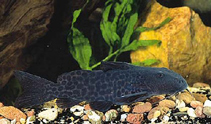
Coloration: preserved specimens dark brown; according to Daget (1954), colour in life «olivaceous yellow on back and sides, lighter on belly»; body and adipose fin covered with large black spots, which become smaller on belly and on other fins (Ref. 57223).
Body shape (shape guide): fusiform / normal.
Maximum TL was recorded at 60.0 cm (Ref. 57223). Oviparous (Ref. 205).
Cycle de vie et comportement reproducteur
Maturité | Reproduction | Frai | Œufs | Fécondité | Larves
Oviparous (Ref. 205). Distinct pairing during breeding (Ref. 205).
Paugy, D. and T.R. Roberts, 2003. Mochokidae. p. 195-268 In C. Lévêque, D. Paugy and G.G. Teugels (eds.) Faune des poissons d'eaux douce et saumâtres de l'Afrique de l'Ouest, Tome 2. Coll. Faune et Flore tropicales 40. Musée Royal de l'Afrique Centrale, Tervuren, Belgique, Museum National d'Histoire Naturalle, Paris, France and Institut de Recherche pour le Développement, Paris, France. 815 p. (Ref. 57223)
Statut dans la liste rouge de l'IUCN (Ref. 130435: Version 2025-2 (Global))
Menace pour l'homme
Harmless
Utilisations par l'homme
Outils
Articles particuliers
Télécharger en XML
Sources Internet
Estimations basées sur des modèles
Indice de diversité phylogénétique (Réf.
82804): PD
50 = 0.5000 [Uniqueness, from 0.5 = low to 2.0 = high].
Bayesian length-weight: a=0.01096 (0.00461 - 0.02608), b=3.00 (2.81 - 3.19), in cm total length, based on LWR estimates for this Genus-body shape (Ref.
93245).
Niveau trophique (Réf.
69278): 2.8 ±0.3 se; based on size and trophs of closest relatives
Résilience (Réf.
120179): Milieu, temps minimum de doublement de population : 1,4 à 4,4 années (Preliminary K or Fecundity.).
Vulnérabilité de la pêche (Ref.
59153): Moderate vulnerability (43 of 100).
🛈