>
Siluriformes (Catfishes) >
Ariidae (Sea catfishes) > Bagreinae
Etymology: Bagre: Mozarabic, bagre, taken from Greek, pagros = a fish (Dentex sp.) (Ref. 45335).
More on author: Linnaeus.
Taxonomic Remarks
Junior synonym Felichthys filamentosu is a valid species according to Marceniuk et al., 2023 (Ref. 130933:433).
Environnement : milieu / zone climatique / profondeur / gamme de distribution
Écologie
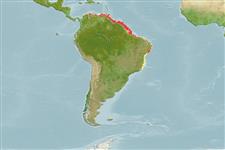
marin; saumâtre démersal; profondeur ? - 50 m (Ref. 5217). Tropical; 12°N - 21°S, 77°W - 34°W
South America: Colombia to the mouth of the Amazon River.
Taille / Poids / Âge
Maturité: Lm ? range ? - ? cm
Max length : 55.0 cm TL mâle / non sexé; (Ref. 5217); common length : 40.0 cm TL mâle / non sexé; (Ref. 3265); poids max. publié: 975.00 g (Ref. 125970)
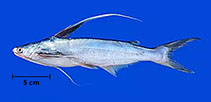
Two pairs of barbels on rostral region, one pair on lower jaw, one pair on posterior end of maxilla; end of maxilla barbel beyond anal fin origin; pectoral spine filament long, reaching anal fin origin; dorsal, pectoral, and pelvic fin membranes black; anal fin membrane black distally (some individuals white), white proximally; body silver gray or blue gray dorsally, silver white ventrally (Ref. 13608).
Body shape (shape guide): elongated.
Chiefly marine, common around river mouths and also entering river estuaries. Feeds on small fishes and invertebrates, such as crustaceans. Marketed fresh.
Cycle de vie et comportement reproducteur
Maturité | Reproduction | Frai | Œufs | Fécondité | Larves
Taylor, W.R. and N.A. Menezes, 1978. Ariidae. In W. Fischer (ed.) FAO species identification sheets for fishery purposes. West Atlantic (Fishing Area 31). volume 1. [pag. var.]. FAO, Rome. (Ref. 3265)
Statut dans la liste rouge de l'IUCN (Ref. 130435: Version 2025-2 (Global))
Menace pour l'homme
Traumatogenic (Ref. 36613)
Utilisations par l'homme
Pêcheries: commercial
Outils
Articles particuliers
Télécharger en XML
Sources Internet
Estimations basées sur des modèles
Température préférée (Réf.
123201): 26.9 - 28.2, mean 27.5 °C (based on 116 cells).
Indice de diversité phylogénétique (Réf.
82804): PD
50 = 0.5625 [Uniqueness, from 0.5 = low to 2.0 = high].
Bayesian length-weight: a=0.00501 (0.00395 - 0.00636), b=3.06 (2.99 - 3.13), in cm total length, based on LWR estimates for this species (Ref.
93245).
Niveau trophique (Réf.
69278): 4.0 ±0.66 se; based on food items.
Generation time: 6.9 ( na - na) years. Estimated as median ln(3)/K based on 1
growth studies.
Résilience (Réf.
120179): Faible, temps minimum de doublement de population : 4,5 à 14 années (Preliminary K or Fecundity.).
Prior r = 0.57, 95% CL = 0.37 - 0.85, Based on 4 data-limited stock assessments.
Vulnérabilité de la pêche (Ref.
59153): Moderate vulnerability (42 of 100).
🛈
Nutriments (Ref.
124155): Calcium = 106 [57, 219] mg/100g; Iron = 0.914 [0.586, 1.493] mg/100g; Protein = 17 [15, 19] %; Omega3 = 0.175 [0.100, 0.301] g/100g; Selenium = 57.3 [30.7, 116.6] μg/100g; VitaminA = 21.3 [9.5, 48.1] μg/100g; Zinc = 1.21 [0.83, 1.82] mg/100g (wet weight);