Environnement : milieu / zone climatique / profondeur / gamme de distribution
Écologie
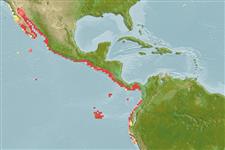
marin démersal; profondeur 50 - 130 m (Ref. 9342). Tropical; 33°N - 9°S, 118°W - 76°W (Ref. 5222)
Eastern Pacific: southern California to Peru. Misidentified as Epinephelus niveatus by some authors (Ref. 5995, 6852).
Taille / Poids / Âge
Maturité: Lm ? range ? - ? cm
Max length : 48.0 cm SL mâle / non sexé; (Ref. 5222)
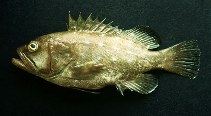
Épines dorsales (Total) : 11; Rayons mous dorsaux (Total) : 13 - 15; Épines anales: 3; Rayons mous anaux: 9. Distinguished by the following characteristics: juveniles dark reddish brown with white spots in grid-like pattern of vertical series and horizontal rows on body and dorsal fin; caudal peduncle with visible dark saddle blotch; pale caudal and pectoral fins; dark brown anal and pelvic fins; black maxillary groove; adults dark brown lacking white spots; depth of body contained 2.3-2.7 times in SL; head length 2.2-2.5 times in SL; convex interorbital area; slightly produced angle of preopercle, with enlarged serrae; distinctly convex upper edge of operculum; vertically elongate posterior nostrils, 2-5 times larger than anterior nostrils; maxilla reaches to or beyond vertical at rear edge of eye; 2 rows of teeth on midlateral part of lower jaw (Ref. 89707).
Body shape (shape guide): fusiform / normal; Cross section: compressed.
Found on rocky reefs and soft bottoms (Ref. 89707). Reported to be often caught in shrimp trawls in central Gulf of California. Too rare to be of commercial interest.
Cycle de vie et comportement reproducteur
Maturité | Reproduction | Frai | Œufs | Fécondité | Larves
Craig, M.T. and P.A. Hastings, 2007. A molecular phylogeny of the groupers of the subfamily Epinephelinae (Serranidae) with revised classification of the epinephelini. Ichthyol. Res. 54:1-17. (Ref. 83414)
Statut dans la liste rouge de l'IUCN (Ref. 130435: Version 2025-2 (Global))
Menace pour l'homme
Harmless
Utilisations par l'homme
Pêcheries: pêcheries vivrières; pêche sportive: oui
Outils
Articles particuliers
Télécharger en XML
Sources Internet
Estimations basées sur des modèles
Température préférée (Réf.
123201): 15.6 - 23.1, mean 17.2 °C (based on 19 cells).
Indice de diversité phylogénétique (Réf.
82804): PD
50 = 0.5000 [Uniqueness, from 0.5 = low to 2.0 = high].
Bayesian length-weight: a=0.01318 (0.00598 - 0.02904), b=3.04 (2.87 - 3.21), in cm total length, based on LWR estimates for this Genus-body shape (Ref.
93245).
Niveau trophique (Réf.
69278): 3.8 ±0.7 se; based on size and trophs of closest relatives
Résilience (Réf.
120179): Milieu, temps minimum de doublement de population : 1,4 à 4,4 années (Preliminary K or Fecundity.).
Vulnérabilité de la pêche (Ref.
59153): Moderate vulnerability (43 of 100).
🛈
Nutriments (Ref.
124155): Calcium = 99.3 [39.1, 183.2] mg/100g; Iron = 0.847 [0.447, 1.672] mg/100g; Protein = 18 [16, 20] %; Omega3 = 0.274 [0.161, 0.485] g/100g; Selenium = 56.8 [28.6, 119.5] μg/100g; VitaminA = 29.4 [9.3, 106.2] μg/100g; Zinc = 0.892 [0.613, 1.347] mg/100g (wet weight);