>
Tetraodontiformes (Puffers and filefishes) >
Balistidae (Triggerfishes)
Etymology: Melichthys: Greek, melas, melaina, melan, black + icthys yos, fish. On the other hand, in Smith et al.,1986: 878), 'body dark brown to black' in https://www.biodiversitylibrary.org/item/266635#page/902/mode/1up.(P. Romero, pers.comm. 03/2022).
More on author: Bloch.
Environnement : milieu / zone climatique / profondeur / gamme de distribution
Écologie
marin récifal; profondeur 0 - 75 m (Ref. 9710), usually 0 - 20 m (Ref. 40849). Tropical; 30°N - 29°S, 180°W - 180°E
Circumglobal. Uncommon in most areas but abundant around isolated oceanic islands (Ref. 9710).
Taille / Poids / Âge
Maturité: Lm ? range ? - ? cm
Max length : 50.0 cm TL mâle / non sexé; (Ref. 5217); common length : 30.0 cm TL mâle / non sexé; (Ref. 3272)
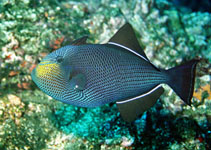
Épines dorsales (Total) : 3; Rayons mous dorsaux (Total) : 30 - 34; Épines anales: 0; Rayons mous anaux: 28 - 30. This species is distinguished by the following characters: a deep groove in front of eye; 20-25 head scale rows from corner of mouth to lower end of gill opening; 57-66 body scale rows from upper end of gill opening to caudal fin base; presence of prominent longitudinal ridges following scale rows of posterior body; slightly rounded to double emarginate caudal fin; a thin white bar neat posterior margin of the caudal fin; black spots on scales forming lines (Ref. 90102).
Body shape (shape guide): short and / or deep; Cross section: compressed.
Inhabit clear seaward reefs. More common around oceanic islands (Ref. 9276). Found on inner and outer reef crests, usually near the slope or drop-off to deeper water, where in small but loose aggregations. Sometimes swim high above substrate feeding on zooplankton (Ref. 48637). May also be solitary (Ref. 90102). Benthopelagic (Ref. 58302). Diet consists primarily of calcareous algae and zooplankton (Ref. 1602); also feed on phytoplankton (Ref. 5213). At Fernando de Noronha Archipelago, southeast Atlantic, groups of about 100 individuals join groups of spinner dolphins to feed on feces and vomits of the cetaceans when they congregate in a shallow bay for rest and social interactions. The postures a dolphin adopts prior to defecating or vomiting are recognized, and the fish begin to converge to the dolphin shortly before the actual voiding. Offal feeding may be regarded as a simple behavioral shift from plankton feeding to drifting offal picking (Ref. 48727). Marketed fresh (Ref. 9770). Minimum depth reported taken from Ref. 128797.
Cycle de vie et comportement reproducteur
Maturité | Reproduction | Frai | Œufs | Fécondité | Larves
Oviparous, distinct pairing during breeding (Ref. 205).
Matsuura, K., 2001. Balistidae. Triggerfishes. p. 3911-3928. In K.E. Carpenter and V. Niem (eds.) FAO species identification guide for fishery purposes. The living marine resources of the Western Central Pacific. Vol. 6. Bony fishes part 4 (Labridae to Latimeriidae), estuarine crocodiles. FAO, Rome. (Ref. 9770)
Statut dans la liste rouge de l'IUCN (Ref. 130435: Version 2025-2 (Global))
Menace pour l'homme
Harmless
Utilisations par l'homme
Pêcheries: intérêt commercial mineur; Aquarium: Commercial
Outils
Articles particuliers
Télécharger en XML
Sources Internet
Estimations basées sur des modèles
Température préférée (Réf.
123201): 24.4 - 28.9, mean 27.4 °C (based on 1548 cells).
Indice de diversité phylogénétique (Réf.
82804): PD
50 = 0.6250 [Uniqueness, from 0.5 = low to 2.0 = high].
Bayesian length-weight: a=0.02754 (0.01326 - 0.05722), b=2.91 (2.74 - 3.08), in cm total length, based on LWR estimates for this (Sub)family-body shape (Ref.
93245).
Niveau trophique (Réf.
69278): 2.4 ±0.0 se; based on diet studies.
Résilience (Réf.
120179): Milieu, temps minimum de doublement de population : 1,4 à 4,4 années (Preliminary K or Fecundity.).
Vulnérabilité de la pêche (Ref.
59153): Moderate vulnerability (40 of 100).
🛈
Nutriments (Ref.
124155): Calcium = 22.1 [8.5, 59.3] mg/100g; Iron = 0.571 [0.293, 1.352] mg/100g; Protein = 18.7 [16.5, 20.9] %; Omega3 = 0.15 [0.08, 0.31] g/100g; Selenium = 21 [9, 49] μg/100g; VitaminA = 24 [5, 107] μg/100g; Zinc = 0.775 [0.488, 1.276] mg/100g (wet weight);