Environnement : milieu / zone climatique / profondeur / gamme de distribution
Écologie
; eau douce benthopélagique; pH range: 6.5 - 7.2; non migrateur. Tropical; 22°C - 25°C (Ref. 31267); 1°S - 2°S
Africa: Lake Victoria drainage in Tanzania, Kenya and Uganda (Ref. 47311). Also in Lake Kioga, Lake George, Lake Edward, Lake Albert and adjacent river systems like Rutshuru River and Semliki River (Ref. 47311).
Taille / Poids / Âge
Maturité: Lm ? range ? - ? cm
Max length : 5.0 cm TL mâle / non sexé; (Ref. 27139)
Description synthétique
Clés d'identification | Morphologie | Morphométrie
Épines dorsales (Total) : 0; Épines anales: 0. Diagnosis: A short and robust Aplocheilichthys species of relatively small size with rounded fins (Ref. 47311).
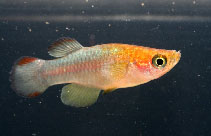
Colouration: The colour is quite variable in males (Ref. 47311). In general, the sides are an iridescent grass-green to blue-green; on the frontal part of the body and the back this may change to a golden green or bronze-green; the latter colour may cover the body entirely in some populations; the scales on the back and sides have narrow dark gray borders, which may be more distinct on scales along the mid-lateral line; at the upper end of the operculum, forward of the pectoral fins, is a black, vertical oblong marking (Ref. 47311). The colour of the unpaired fins is also variable and ranges from dark gray or almost black to grass-green or bronze; dark gray or red to red-brown margins may be present (Ref. 47311). Some populations may include specimens with orange-red fins, while in others the orange-red colour is limited to the margins of the unpaired fins (Ref. 47311). Females are light gray-brown to gray; very narrow, dark gray margins to the scales produce a faint reticulation on the sides which is best developed along the mid-lateral line, resulting in a faint longitudinal line in some cases; the ventral parts are silver; all fins are colourless (Ref. 47311). Both sexes show a silver reflection in the iris, the upper part being green in the male (Ref. 47311).
Body shape (shape guide): elongated.
Found in shallow parts of papyrus swamps of Lake Victoria; also found in river mouths, rice fields and ditches connected to lakes (Ref. 3788, 47311). Sexual maturity is reached at an age of about 6 months (Ref. 47311). Not a seasonal killifish (Ref. 27139).
Cycle de vie et comportement reproducteur
Maturité | Reproduction | Frai | Œufs | Fécondité | Larves
Seegers, L., 1997. Killifishes of the world: Old world killis I: (Aphyosemion, lampeyes, ricefishes). Aqualog, Verlag: A.C.S. Gmbh, Germany. 160 p. (Ref. 31267)
Statut dans la liste rouge de l'IUCN (Ref. 130435: Version 2025-2 (Global))
Menace pour l'homme
Harmless
Utilisations par l'homme
Aquarium: Commercial
Outils
Articles particuliers
Télécharger en XML
Sources Internet
Estimations basées sur des modèles
Indice de diversité phylogénétique (Réf.
82804): PD
50 = 0.5000 [Uniqueness, from 0.5 = low to 2.0 = high].
Bayesian length-weight: a=0.00562 (0.00224 - 0.01412), b=3.07 (2.85 - 3.29), in cm total length, based on LWR estimates for this (Sub)family-body shape (Ref.
93245).
Niveau trophique (Réf.
69278): 3.0 ±0.3 se; based on size and trophs of closest relatives
Vulnérabilité de la pêche (Ref.
59153): Low vulnerability (10 of 100).
🛈