This website uses cookies to enhance your browsing experience and ensure the functionality of our site. For more detailed information about the types of cookies we use and how we protect your privacy, please visit our Privacy Information page.
×
Cookie Settings
This website uses different types of cookies to enhance your experience. Please select your preferences below:
分类 / 名称 俗名 | 同种异名 | Catalog of Fishes(属, 种) | ITIS | CoL | WoRMS | Cloffa
Teleostei > Cypriniformes (Carps) > Leuciscidae (Minnows) > Leuciscinae
Etymology: Iberochondrostoma:Name referring to the Iberian Peninsula where the genus is distributed.
Europe: Portugal in Sado, Lizandro, Samarra, Colares and Ossos drainages, south bank tributaries of Tagus. Reported from the Iberian Peninsula in Portugal and Spain (Ref. 119049). 歐洲: 葡萄牙。 在伯恩公約的附錄 3 中 (受保育的動物群).
大小 / 重量 / 年龄
成熟度: Lm? range ? - ? cm Max length : 15.1 cm TL 雄鱼/尚未辨别雌雄; (Ref. 55426)
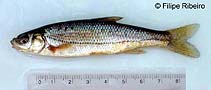
背棘 (总数) : 3; 背的软条 (总数) : 6 - 8; 臀棘: 3; 臀鳍软条: 6 - 8. Diagnosis: Lateral line scales (43)45-49(51); above lateral line (9.5)10-11(10.5); right pharyngeal teeth 5-6 (Ref. 55426). Differs from its congeners by having eye diameter greater than snout length, usually 43-47 + 2-3 scales on lateral line and 3½-5 scale rows between lateral line and pelvic origin (Ref. 59043).
Found in coastal rivers and terminal segments of main rivers (Ref. 26100). Adults occur in middle and lower reaches of streams, with slow current and underwater vegetation. They form large spawning aggregations (Ref. 59043). Threatened due to habitat destruction (Ref. 26100). Migration pattern is inferred from the behavior of other species in the same genus (Ref. 138297).
Forms large spawning aggregations. A female spawns with one or a few males, which press the female against the substratum and eggs are released. These movements attract other individuals to start spawning. The aggregations disperse after about 20-60 seconds and many form again several times. Deposits adhesive eggs (Ref. 59043).歐洲: 葡萄牙。 在伯恩公約的附錄 3 中 (受保育的動物群).
系统发育多样性指数 (参考文献 82804): PD50 = 0.5312 [Uniqueness, from 0.5 = low to 2.0 = high].
Bayesian length-weight: a=0.00832 (0.00390 - 0.01775), b=3.09 (2.91 - 3.27), in cm total length, based on LWR estimates for this (Sub)family-body shape (Ref. 93245).
营养阶层 (参考文献 69278): 2.9 ±0.4 se; based on size and trophs of closest relatives
回复力 (参考文献 120179): 中等的, 族群倍增时间最少 1.4 - 4.4年 (Preliminary K or Fecundity.).
渔业脆弱性 (Ref. 59153): Low vulnerability (10 of 100). 🛈