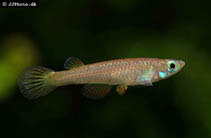
Umwelt: Milieu / Klimazone / Tiefenbereich / Verbreitungsgebiet
Ökologie
; süßwasser benthopelagisch; standorttreu. Tropical; 23°C - 28°C (Ref. 12468)
Africa: from southeastern Ghana, through southern Togo and southern Benin, to southern Nigeria, including the Niger Delta (Ref. 57261).
Größe / Gewicht / Alter
Geschlechtsreife: Lm ? range ? - ? cm
Max length : 3.5 cm TL Männchen/unbestimmt; (Ref. 27139)
Kurzbeschreibung
Bestimmungsschlüssel | Morphologie | Morphometrie
Rückenflossenstacheln (insgesamt) : 0; Rückenflossenweichstrahlen (insgesamt) : 6 - 8; Afterflossenstacheln: 0; Afterflossenweichstrahlen: 12 - 14. Diagnosis: This species is distinguished from congeners by the open pre-opercular neuromast system, beginning of the dorsal fin completely behind the anal fin and male and female colouration, without dark crossbars (Ref. 57261).
Not a seasonal killifish (Ref. 27139). It forms schools near the water surface and is usually found in clear water, in small rivers, brooks and swamps in the primary and secondary rainforest of the coastal plains (Ref. 57261).
Lebenszyklus und Paarungsverhalten
Geschlechtsreife | Fortpflanzung | Ablaichen | Eier | Fruchtbarkeit | Larven
Wildekamp, R.H. and J.R. Van der Zee, 2003. Aplocheilidae. p. 325-442 In C. Lévêque, D. Paugy and G.G. Teugels (eds.) Faune des poissons d'eaux douce et saumâtres de l'Afrique de l'Ouest, Tome 2. Coll. Faune et Flore tropicales 40. Musée Royal de l'Afrique Centrale, Tervuren, Belgique, Museum National d'Histoire Naturalle, Paris, France and Institut de Recherche pour le Développement, Paris, France. 815 p. (Ref. 57261)
IUCN Rote Liste Status (Ref. 130435: Version 2025-2 (Global))
Bedrohung für Menschen
Harmless
Nutzung durch Menschen
Tools
Zusatzinformationen
Download XML
Internet Quellen
Schätzungen auf der Grundlage von Modellen
Phylogenetischer Diversitätsindex (Ref.
82804): PD
50 = 1.0000 [Uniqueness, from 0.5 = low to 2.0 = high].
Bayesian length-weight: a=0.00603 (0.00250 - 0.01453), b=3.13 (2.93 - 3.33), in cm total length, based on LWR estimates for this (Sub)family-body shape (Ref.
93245).
Trophische Ebene (Ref.
69278): 3.1 ±0.4 se; based on size and trophs of closest relatives
Anfälligkeit der Fischerei (Ref.
59153): Low vulnerability (10 of 100).
🛈