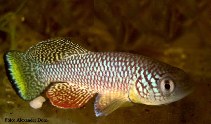
>
Cyprinodontiformes (Rivulines, killifishes and live bearers) >
Nothobranchiidae (African rivulines)
Etymology: Nothobranchius: Greek, nothos = false + Greek, brangchia = gill (Ref. 45335).
Eponymy: Richard E Furzer was an American hobbyist aquarist and aviculturist who discovered this species in Zimbabwe (1968) where he grew up and spent 25 years. [...] (Ref. 128868), visit book page.
Environnement : milieu / zone climatique / profondeur / gamme de distribution
Écologie
; eau douce benthopélagique; pH range: 6.5 - 7.0; dH range: 4 - 15; non migrateur. Tropical; 23°C - 30°C (Ref. 2060); 21°S - 23°S
Africa: Pans in Ghona-re-Zhou Game Reserve in southeastern Zimbabwe. Reported from Save River (Ref. 13332). Extremely rare and is threatened by habitat destruction and insecticide spraying.
Longueur à la première maturité / Taille / Poids / Âge
Maturité: Lm 3.2 range ? - ? cm
Max length : 6.5 cm TL mâle / non sexé; (Ref. 27139)
Description synthétique
Clés d'identification | Morphologie | Morphométrie
Épines dorsales (Total) : 0; Rayons mous dorsaux (Total) : 14 - 15; Épines anales: 0; Rayons mous anaux: 14 - 16.
Occurs in temporary pools (Ref. 3788). Bottom spawner, 5-7 months incubation (Ref. 27139). Annual species with a lifespan of less than 12 weeks in captivity, suggested to be the shortest lifespan ever reported for a vertebrate (Ref. 47810); but life span of Eviota sigillata might be even shorter at 59 days at most (Ref. 54199).
Cycle de vie et comportement reproducteur
Maturité | Reproduction | Frai | Œufs | Fécondité | Larves
Annual fishes. This updates previous information from Ref. 2060. Before their seasonal habitat disappears adults spawn and lay eggs in the muddy bottom. Embryos survive encased in dry mud in a dormant state and hatch at the onset of the next rainy season to repeat the life cycle (Ref. 47810).
Huber, J.H., 1996. Killi-Data 1996. Updated checklist of taxonomic names, collecting localities and bibliographic references of oviparous Cyprinodont fishes (Atherinomorpha, Pisces). Société Française d'Ichtyologie, Muséum National d'Histoire Naturelle, Paris, France, 399 p. (Ref. 27139)
Statut dans la liste rouge de l'IUCN (Ref. 130435: Version 2025-2 (Global))
Menace pour l'homme
Harmless
Utilisations par l'homme
Pêcheries: sans intérêt
Outils
Articles particuliers
Télécharger en XML
Sources Internet
Estimations basées sur des modèles
Indice de diversité phylogénétique (Réf.
82804): PD
50 = 0.5000 [Uniqueness, from 0.5 = low to 2.0 = high].
Bayesian length-weight: a=0.00603 (0.00250 - 0.01453), b=3.13 (2.93 - 3.33), in cm total length, based on LWR estimates for this (Sub)family-body shape (Ref.
93245).
Niveau trophique (Réf.
69278): 3.2 ±0.4 se; based on size and trophs of closest relatives
Résilience (Réf.
120179): Haut, temps minimum de doublement de population inférieur à 15 mois (tm=0.04).
Vulnérabilité de la pêche (Ref.
59153): Low vulnerability (10 of 100).
🛈