>
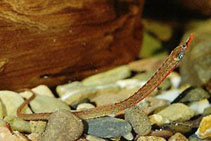
Syngnathiformes (Pipefishes and seahorses) >
Syngnathidae (Pipefishes and seahorses) > Syngnathinae
Etymology: Enneacampus: Greek, ennea = nine times + Greek, kampe = curvature (Ref. 45335).
Eponymy: Dr William John Ansorge (1850–1913) was an English explorer and collector who was active in Africa in the second half of the 19th century. [...] (Ref. 128868), visit book page.
More on author: Boulenger.
Environnement : milieu / zone climatique / profondeur / gamme de distribution
Écologie
; eau douce; saumâtre démersal; pH range: 7.0 - 7.5; dH range: 10 - 18. Tropical; 24°C - 28°C (Ref. 1672)
Africa: western coast of Africa from the Gambia river drainage (Gambia) to the Cuanza river (Angola) (Ref. 4127, 81680).
Taille / Poids / Âge
Maturité: Lm ? range ? - ? cm
Max length : 13.6 cm SL mâle / non sexé; (Ref. 81680)
Épines dorsales (Total) : 0; Rayons mous dorsaux (Total) : 22 - 29; Épines anales: 0; Rayons mous anaux: 2 - 3. Diagnosis: 11-15 (median 13) pectoral fin rays; head length 8.4-10.8 (mean 9.4) times in SL (Ref. 57226, 81680). Snout tubular, relatively short (Ref. 57226), ratio head length/snouth length 2.0-2.8 (mean 2.5)(Ref. 57226, 81680).
Body shape (shape guide): eel-like.
Adults occur in coastal rivers and streams (Ref. 4127, 81680), and swamps (Ref. 57226, 81680). Seems confined to fresh water habitats and breeds in fresh water (Ref. 81680). Ovoviviparous (Ref. 205). Feeds (mainly) on copepods (Ref. 81680). Male carries the eggs in a brood pouch which is found under the tail (Ref. 205). Dawson (1981) reported 17-36 postlarvae in the brood pouch of males of 75.5-82.5 mm SL; a larger male (MRAC 143259: 136.4 mm SL) caught in December 1964, in a swampy area about 200 m from the coast of Bioko Island (formerly Fernando Poo), has its brood pouch filled with several hundred postlarvae (Ref. 81680).
Cycle de vie et comportement reproducteur
Maturité | Reproduction | Frai | Œufs | Fécondité | Larves
Male carries the eggs in a brood pouch (Ref. 205).
Dawson, C.E., 1986. Syngnathidae. p. 281-287. In J. Daget, J.-P. Gosse and D.F.E. Thys van den Audenaerde (eds.) Check-list of the freshwater fishes of Africa (CLOFFA). ISNB, Brussels; MRAC, Tervuren; and ORSTOM, Paris. Vol. 2. (Ref. 4127)
Statut dans la liste rouge de l'IUCN (Ref. 130435: Version 2025-2 (Global))
Menace pour l'homme
Harmless
Utilisations par l'homme
Outils
Articles particuliers
Télécharger en XML
Sources Internet
Estimations basées sur des modèles
Indice de diversité phylogénétique (Réf.
82804): PD
50 = 0.7500 [Uniqueness, from 0.5 = low to 2.0 = high].
Bayesian length-weight: a=0.00035 (0.00015 - 0.00079), b=3.19 (3.00 - 3.38), in cm total length, based on LWR estimates for this (Sub)family-body shape (Ref.
93245).
Niveau trophique (Réf.
69278): 3.3 ±0.5 se; based on size and trophs of closest relatives
Résilience (Réf.
120179): Haut, temps minimum de doublement de population inférieur à 15 mois (Preliminary K or Fecundity.).
Vulnérabilité de la pêche (Ref.
59153): Low vulnerability (10 of 100).
🛈