>
Carangaria/misc (Various families in series Carangaria) >
Latidae (Lates perches)
Etymology: Lates: Latin, lateo, latere = to be hidden.
Eponymy: Marie Horn, with her husband Adolf, collected fishes at Lake Tanganyika (1908). [There is also a mention of the brothers Adolf and Albin Horn visiting Tanganyika in 1913, but almost nothing else is recorded about them] (Ref. 128868), visit book page.
More on author: Steindachner.
Umwelt: Milieu / Klimazone / Tiefenbereich / Verbreitungsgebiet
Ökologie
; süßwasser demersal; tiefenbereich ? - 75 m (Ref. 36901). Tropical; 3°S - 9°S
Africa: Lake Tanganyika (Ref. 2216, 36901); widely distributed throughout the lake (Ref. 36901). In the Lukuga River (Lake Tanganyika outflow), known up to Niemba (Ref. 93587). In the Malagarazi River, known from the delta and the lower reaches (Ref. 54847).
Länge bei der ersten Reifung / Größe / Gewicht / Alter
Geschlechtsreife: Lm 45.5 range ? - ? cm
Max length : 80.0 cm TL Männchen/unbestimmt; (Ref. 3636)
Kurzbeschreibung
Bestimmungsschlüssel | Morphologie | Morphometrie
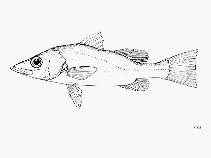
Juveniles live in a specific inshore habitat until they reach 18 cm, thereafter they adopt a benthic habitat moving into deep water (Ref. 2216). Juveniles have been observed near or in affluent rivers (Ref. 36901). Top predator in depths below 100 m; exploits both fishes and invertebrates; migrate diurnally to surface to feed on pelagic clupeids; highly susceptible to intensive fishing (Ref. 2216).
Lebenszyklus und Paarungsverhalten
Geschlechtsreife | Fortpflanzung | Ablaichen | Eier | Fruchtbarkeit | Larven
Coulter, G.W., 1976. The biology of Lates species in Lake Tanganyika, and the status of the pelagic fishery for Lates species and Luciolates stapersii. J. Fish Biol. 9(3):235-259. (Ref. 2216)
IUCN Rote Liste Status (Ref. 130435: Version 2025-2 (Global))
Bedrohung für Menschen
Harmless
Nutzung durch Menschen
Fischereien: kommerziell; Sportfisch: ja
Tools
Zusatzinformationen
Download XML
Internet Quellen
Schätzungen auf der Grundlage von Modellen
Phylogenetischer Diversitätsindex (Ref.
82804): PD
50 = 0.5005 [Uniqueness, from 0.5 = low to 2.0 = high].
Bayesian length-weight: a=0.00977 (0.00566 - 0.01687), b=2.99 (2.84 - 3.14), in cm total length, based on LWR estimates for this species & Genus-body shape (Ref.
93245).
Trophische Ebene (Ref.
69278): 4.2 ±0.69 se; based on food items.
Widerstandsfähigkeit (Ref.
120179): niedrig, Verdopplung der Population dauert 4,5 - 14 Jahre. (tmax=12-13).
Anfälligkeit der Fischerei (Ref.
59153): Moderate vulnerability (40 of 100).
🛈
Nährstoffe (Ref.
124155): Calcium = 167 [35, 355] mg/100g; Iron = 1.61 [0.79, 3.86] mg/100g; Protein = 19.5 [18.1, 21.0] %; Omega3 = 0.425 [0.174, 1.059] g/100g; Selenium = 178 [46, 512] μg/100g; VitaminA = 36.4 [8.4, 166.4] μg/100g; Zinc = 1.01 [0.43, 2.21] mg/100g (wet weight);