>
Eupercaria/misc (Various families in series Eupercaria) >
Haemulidae (Grunts) > Plectorhinchinae
Etymology: Plectorhinchus: Greek, plektos = plaited + Greek, rhyngchos = snout (Ref. 45335).
More on author: Boulenger.
Entorno: milieu / zona climática / rango de profundidad / gama de distribución
Ecología
marino; salobre bentopelágico; rango de profundidad 10 - ? m (Ref. 2683). Tropical; 15°N - 13°S
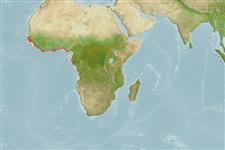
Eastern Atlantic: west African coast, from Senegal to Democratic Republic of Congo (Ref. 81655) and Angola (Ref. 7376, 57395).
Tamaño / Peso / Edad
Madurez: Lm ? range ? - ? cm
Max length : 53.8 cm TL macho / no sexado; (Ref. 126428); common length : 30.0 cm TL macho / no sexado; (Ref. 5476); peso máximo publicado: 2.8 kg (Ref. 126428)
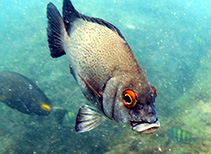
Espinas dorsales (total) : 14; Radios blandos dorsales (total) : 16; Espinas anales: 3; Radios blandos anales: 7. Diagnosis: body oblong, rather deep; dorsal profile strongly convex at level of dorsal-fin origin (Ref. 57395). Snout at least as long as eye diameter (Ref. 57395), eyes large (Ref. 81655). Mouth oblique (Ref. 57395), small (Ref. 81655) with very thick (Ref. 57395) and fleshy (Ref. 81655) lips. Chin with 6 pores (erroneously reported as 4 since original species description; Ref. 81655), but without median pit (Ref. 57395). Dorsal fin long; second anal fin spine longest and stoutest; ctenoid scales covering body and head (except snout) and interradial membranes of soft parts of dorsal and anal fins (Ref. 57395). Caudal fin rounded (Ref. 57395, 81655).
Coloration: uniformly brown, more or less dark; young individuals often with lighter spots on flanks (Ref. 57395, 81655). In small specimens (< 60 mm SL), distal part of soft dorsal fin, posterior 3/4 of caudal fin and distal part of anal fin transparent (Ref. 81655).
Body shape (shape guide): fusiform / normal; Cross section: compressed.
Relatively rare species (Ref. 57395). Inhabits coastal waters (Ref. 3660, 57395), estuaries and coastal lagoons (Ref. 2683). Juveniles and sub-adults often in estuaries and lagoons (Ref. 2135, 57395, 81655), in freshwater (Ref. 2135), where sexual maturation begins (Ref. 57395).
Ciclo vital y comportamiento de apareamiento
Madurez | Reproducción | Puesta | Huevos | Fecundidad | Larva
Oviparous, distinct pairing during breeding (Ref. 205).
Roux, C., 1990. Haemulidae. p. 783-788. In J.C. Quero, J.C. Hureau, C. Karrer, A. Post and L. Saldanha (eds.) Check-list of the fishes of the eastern tropical Atlantic (CLOFETA). JNICT, Lisbon; SEI, Paris; and UNESCO, Paris. Vol. 2. (Ref. 6946)
Situación en la Lista Roja de la UICN (Ref. 130435: Version 2025-2 (Global))
Amenaza para el ser humano
Harmless
Usos humanos
Pesquerías: comercial
Herramientas
Informes especiales
Descargar XML
Fuentes de Internet
Estimaciones basadas en modelos
Temperatura preferida (Referencia
123201): 22.6 - 27.9, mean 26.3 °C (based on 40 cells).
Índice de diversidad filogenética (Referencia
82804): PD
50 = 0.5000 [Uniqueness, from 0.5 = low to 2.0 = high].
Bayesian length-weight: a=0.01622 (0.00866 - 0.03037), b=2.95 (2.79 - 3.11), in cm total length, based on LWR estimates for this species & Genus-body shape (Ref.
93245).
Nivel trófico (Referencia
69278): 3.8 ±0.6 se; based on size and trophs of closest relatives
Resiliencia (Referencia
120179): Medio, población duplicada en un tiempo mínimo de 1.4-4.4 años (Preliminary K or Fecundity.).
Vulnerabilidad pesquera (Ref.
59153): Moderate vulnerability (42 of 100).
🛈
Vulnerabilidad climática (Ref.
125649): Very high vulnerability (89 of 100).
🛈
Nutrientes (Ref.
124155): Calcium = 72.6 [20.8, 161.1] mg/100g; Iron = 0.726 [0.384, 1.531] mg/100g; Protein = 17.8 [15.9, 19.8] %; Omega3 = 0.176 [0.077, 0.347] g/100g; Selenium = 56.4 [26.6, 114.0] μg/100g; VitaminA = 20.4 [7.2, 56.7] μg/100g; Zinc = 1.19 [0.77, 1.83] mg/100g (wet weight);