>
Gobiiformes (Gobies) >
Gobiidae (Gobies) > Gobiinae
Etymology: Nematogobius: Greek, nemas, -atos = filament + Latin, gobius = gudgeon (Ref. 45335).
Eponymy: Maurice Maindron (1857–1911) was a French naturalist, collector and entomologist. [...] (Ref. 128868), visit book page.
More on author: Sauvage.
Milieu: milieu / Klimaatzone / Diepte / verspreidingsgebied
Ecologie
marien; zoet water; brak water demersaal; amfidroom (Ref. 46888). Tropical; 20°C - 25°C (Ref. 12468)
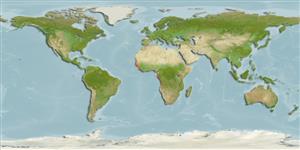
Eastern Atlantic: Senegal to Angola (Ref. 57403), including the Gulf of Guinea and offshore islands (Ref. 4343, 79590). Also reported from the Cunene in Namibia (Ref. 33857) and Angola (Ref. 120641).
Grootte / Gewicht / Leeftijd
Maturiteit: Lm ? range ? - ? cm
Max length : 8.0 cm TL mannelijk / geslacht onbekend; (Ref. 57403)
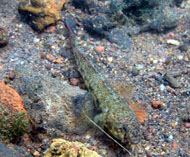
Dorsale stekels (totaal) : 7; Dorsale zachte stralen (totaal) : 11 - 12; Anale stekels: 1; Anale zachte stralen: 9 - 10. Diagnosis: mental barbels long, nasal barbels shorter; 4-5 rows of teeth in upper jaw, teeth in outer row larger than teeth in inner rows, which are curved posteriorly; 4 rows of slightly recurved teeth in lower jaw, outer row with largest teeth, except for mid-lateral teeth of inner row, which are similar in size to teeth in outer row; operculum, suboperculum and suborbital region scaleless; nape with some (maximum 14) small cycloid predorsal scales in a narrow band, not extending anteriorly beyond level of preoperculum; scales on abdomen smaller than those on flanks; 30-34 (usually 33 or 34) ctenoid scales in a longitudinal series (including 2 scales on caudal fin base), and 10-12 (usually 11) in rearward transverse series; 1st dorsal fin: VI; 2nd dorsal fin: I,11-12; anal fin: I,9-10; pectoral fins: 18-19 (rarely 17); caudal fin with 16-17 segmented rays, 14-15 of which are branched (Ref. 57403, 79590).
Coloration: Preserved specimens: light brown, with dark spots on flanks forming up to 10 irregular, dark cross bars, darkest at lateral midline; dorsal-fin rays with 3-4 spots, forming irregular longitudinal bands on fins; pectorals with a dark spot at upper part of base, distinct in life but fading after lengthy or poor preservation; caudal fin with spots forming vertical bands (Ref. 57403, 79590). In life: bands and spots on fins more distinct; body yellowish ventrally, yellowish brown dorsally; suborbital region with alternating yellow and dark patches (Ref. 57403, 79590).
Body shape (shape guide): fusiform / normal.
Common in brackish waters of estuaries, but may migrate up rivers into freshwaters, often at considerable distance from the sea (Ref. 57403, 79590). Maximum reported standard length 65.1 mm (=78 mm TL)(Ref. 79590).
Levenscyclus en paargedrag
Maturiteit | Voortplanting | Paaien | Eieren | Fecunditeit | Larven
Harrison, I.J., P.J. Miller and F. Pezold, 2003. Gobiidae. p. 625-666 In C. Lévêque, D. Paugy and G.G. Teugels (eds.) Faune des poissons d'eaux douce et saumâtres de l'Afrique de l'Ouest, Tome 2. Coll. Faune et Flore tropicales 40. Musée Royal de l'Afrique Centrale, Tervuren, Belgique, Museum National d'Histoire Naturalle, Paris, France and Institut de Recherche pour le Développement, Paris, France. 815 p. (Ref. 57403)
Status op de Rode Lijst van het IUCN (Ref. 130435: Version 2025-2 (Global))
Gevaar voor de mens
Harmless
Gebruik door de mens
Visserij: van geen belang
Tools
Speciale rapporten
Download XML
Internetbronnen
Schattingen op basis van modellen
Gewenste temperatuur (Ref.
123201): 19 - 27.9, mean 25.6 °C (based on 330 cells).
Fylogenetische diversiteitsindex (Ref.
82804): PD
50 = 0.7500 [Uniqueness, from 0.5 = low to 2.0 = high].
Bayesian length-weight: a=0.00741 (0.00347 - 0.01582), b=3.09 (2.91 - 3.27), in cm total length, based on LWR estimates for this (Sub)family-body shape (Ref.
93245).
Trofisch niveau (Ref.
69278): 3.3 ±0.3 se; based on size and trophs of closest relatives
Weerstandsvermogen (Ref.
120179): Hoog, minimale populatieverdubbelingstijd minder dan 15 maanden (Preliminary K or Fecundity.).
Kwetsbaarheid van de visserij (Ref.
59153): Low vulnerability (10 of 100).
🛈
Voedingsstoffen (Ref.
124155): Calcium = 441 [232, 1,021] mg/100g; Iron = 1.54 [0.85, 2.96] mg/100g; Protein = 17.4 [15.5, 18.9] %; Omega3 = 0.177 [0.070, 0.377] g/100g; Selenium = 40.4 [19.0, 109.2] μg/100g; VitaminA = 32.3 [10.5, 88.5] μg/100g; Zinc = 2.57 [1.74, 3.76] mg/100g (wet weight);