Porogobius schlegelii

You can sponsor this page

Porogobius schlegelii (Günther, 1861)

Thêm quan sát của bạn vào Fish Watcher
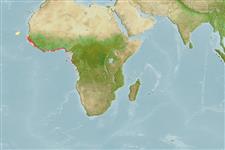
Native range
This map was computer-generated and has not yet been reviewed.
Porogobius schlegelii   AquaMaps   Data sources: GBIF OBIS
Tải lên của bạn hình ảnh Và Video
Google image
Image of Porogobius schlegelii
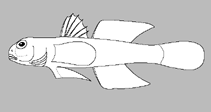
No image available for this species;
drawing shows typical species in Gobiidae.

Phân loại / Tên Tên thường gặp | Các synonym ( Các tên trùng) | Catalog of Fishes(Giống, Các loài) | ITIS | CoL | WoRMS | Cloffa

> Gobiiformes (Gobies) > Gobiidae (Gobies) > Gobiinae
Etymology: Porogobius: Greek, poros = porous + Latin, gobius = gudgeon (Ref. 45335).
Eponymy: Hermann Schlegel (1804–1884) was a German-born zoologist who spent much of his life in the Netherlands. [...] (Ref. 128868), visit book page.
More on author: Günther.

Môi trường: môi trường / vùng khí hậu / Mức độ sâu / phạm vi phân phối Sinh thái học

biển; nước ngọt; thuộc về nước lợ gần đáy; sống cả ở nước ngọt và nuớc mặn (Ref. 46888). Tropical

Sự phân bố Lãnh thổ | Các khu vực của FAO | Các hệ sinh thái | Những lần xuất hiện | Bản đồ điểm | Những chỉ dẫn | Faunafri

Africa: Senegal to Democratic Republic of the Congo (Ref. 7390, 57403, 79590, 80060). Also known from Cape Verde and islands in the Gulf of Guinea (Ref. 5299, 79590).

Bộ gần gũi / Khối lượng (Trọng lượng) / Tuổi

Chín muồi sinh dục: Lm ?  range ? - ? cm
Max length : 18.9 cm TL con đực/không giới tính; (Ref. 128374)

Mô tả ngắn gọn Khóa để định loại | Hình thái học | Sinh trắc học

Các tia vây lưng cứng (tổng cộng) : 7; Các vây lưng mềm (tổng cộng) : 9 - 10; Tia cứng vây hậu môn: 1; Tia mềm vây hậu môn: 8 - 9. Diagnosis: each side of lower jaw with a recurved canine tooth approximately midway along its length (Ref. 57403). Outer row of teeth on lower jaw ending posteriorly in one or more long, recurved teeth (Ref. 79590). Angle of mouth reaching to below anterior margin of eye; 30-35 ctenoid scales in longitudinal series (including about 2-3 scales on caudal fin base), 9 scales in rearward transverse series; 1st dorsal fin: VI; 2nd dorsal fin: I,9 (infrequently 10); anal fin: I,8-9; pectoral fins: 19; pelvic fins just reaching to anus, relatively broad but with thin membrane between spines; caudal fin with 17 segmented rays (usually 14 of which are branched) (Ref. 57403, 79590). Coloration: Preserved specimens: very pale (whitish in alcohol); body covered with numerous small, black spots, larger and more close-set on dorsum; lateral part of head with a dark band running in a crescent from above posterior tip of jaw up towards eye, continuing under ventral margin of eye, and extending posteriorly to dorsal edge of operculum; head with dark, median predorsal band; flanks, below lateral line, with several short vertical bars of fine black dots, darkest bars located at level of 2nd dorsal fin; pectoral fin with dark patch near base of upper rays; just posterior to this there is a band of dark pigment running posteroventrally down upper part of fin; lower, anterior part of pectoral fin bears a narrow, longitudinal, band of dark pigment; other parts of fin with fine black speckling; white longitudinal band along middle of each dorsal fin, and a black longitudinal band along middle of anal fin; pelvic fins with black pigment between rays; caudal fin speckled black, with some dark spots aligned in vertical or slightly oblique rows (Ref. 57403, 79590).
Body shape (shape guide): fusiform / normal.

Sinh học     Tự điển (thí dụ epibenthic)

Occurs inshore, in the intertidal zone (Ref. 4343), in brackish and freshwaters, particularly estuaries, coastal lagoons, mangrove swamps (Ref. 4343, 57403, 79590), creeks and lower river basins (Ref. 57403). Tolerant of fresh waters and may ascend rivers, although less common in these habitats; may establish burrows in subtidal mud (Ref. 79590). Feeds on fish, lamellibranchs, phytoplankton and detritus (Ref. 28587).

Vòng đời và hành vi giao phối Chín muồi sinh dục | Sự tái sinh sản | Đẻ trứng | Các trứng | Sự sinh sản | Ấu trùng

Tài liệu tham khảo chính Tải lên tài liệu tham khảo của bạn | Các tài liệu tham khảo | Người điều phối | Người cộng tác

Harrison, I.J., P.J. Miller and F. Pezold, 2003. Gobiidae. p. 625-666 In C. Lévêque, D. Paugy and G.G. Teugels (eds.) Faune des poissons d'eaux douce et saumâtres de l'Afrique de l'Ouest, Tome 2. Coll. Faune et Flore tropicales 40. Musée Royal de l'Afrique Centrale, Tervuren, Belgique, Museum National d'Histoire Naturalle, Paris, France and Institut de Recherche pour le Développement, Paris, France. 815 p. (Ref. 57403)

Tình trạng Sách đỏ IUCN (Ref. 130435: Version 2025-2 (Global))

  Least Concern (LC) ; Date assessed: 14 June 2019

CITES

Not Evaluated

CMS (Ref. 116361)

Not Evaluated

Mối đe dọa đối với con người

  Harmless


Sử dụng của con người

FAO - Publication: search | FishSource |

Thêm thông tin

Sinh thái dinh dưỡng
Thức ăn (con mồi)
Thành phần thức ăn
Thành phần thức ăn
Khẩu phần ăn
Các động vật ăn mồi
Sinh thái học
Sinh thái học
Biến động dân số
Các thông số tăng trưởng
Độ tuổi / kích thước tối đa
Chiều dài-trọng lượng tương đối
Chiều dài-chiều dài tương đối.
Chiều dài-tần số
Chuyển đổi khối lượng
Bổ xung
Sự phong phú
Vòng đời
Sự tái sinh sản
Chín muồi sinh dục
Độ trưởng thành/Mang liên quan
Sự sinh sản
Đẻ trứng
Tập hợp sinh sản
Các trứng
Sự phát triển của trứng
Ấu trùng
Sự biến động ấu trùng
Sự phân bố
Lãnh thổ
Các khu vực của FAO
Các hệ sinh thái
Những lần xuất hiện
Những chỉ dẫn
BRUVS - Video
Giải phẫu
Vùng mang
Não
sỏi tai
Sinh lý học
Thành phần cơ thể
Chất dinh dưỡng
Thành phần ô-xy
Kiểu bơi
Tốc độ bơi
Sắc tố thị giác
Tiếng cá
Bệnh tật & Ký sinh trùng
Độc tính (LC50)
Di truyền
Bộ gen
Di truyền
Sự dị hợp tử
Di sản
Đa dạng di truyền
Liên quan đến con người
Hệ thống nuôi trồng thủy sản
Các tổng quan nuôi trồng thủy sản
Các giống
Các trường hợp ngộ độc Ciguatera
Tem, tiền xu, v.v.
Tiếp cận
Người cộng tác
Các tài liệu tham khảo

Các công cụ

Báo cáo đặc biệt

Tải xuống XML

Các nguồn internet

AFORO (otoliths) | Aquatic Commons | BHL | Cloffa | Websites from users | Check FishWatcher | CISTI | Catalog of Fishes: Giống, Các loài | DiscoverLife | ECOTOX | FAO - Publication: search | Faunafri | Fishipedia | Fishtrace | GloBI | Google Books | Google Scholar | Google | IGFA World Record | OneZoom | Open Tree of Life | Otolith Atlas of Taiwan Fishes | PubMed | Reef Life Survey | Socotra Atlas | TreeBase | Cây Đời sống | Wikipedia: Go, tìm | World Records Freshwater Fishing | Tạp chí Zoological Record

Ước tính dựa trên mô hình

Nhiệt độ ưa thích (Tài liệu tham khảo 123201): 25.6 - 28, mean 27.4 °C (based on 163 cells).
Chỉ số đa dạng phát sinh loài (Tài liệu tham khảo 82804):  PD50 = 1.0000   [Uniqueness, from 0.5 = low to 2.0 = high].
Bayesian length-weight: a=0.00776 (0.00488 - 0.01236), b=3.05 (2.92 - 3.18), in cm total length, based on LWR estimates for this species & (Sub)family-body (Ref. 93245).
Mức dinh dưỡng (Tài liệu tham khảo 69278):  2.9   ±0.38 se; based on food items.
Thích nghi nhanh (Tài liệu tham khảo 120179):  Trung bình, thời gian nhân đôi của chủng quần tối thiểu là 1.4 - 4.4 năm (Preliminary K or Fecundity.).
Sự dễ bị tổn thương của nghề đánh cá (Ref. 59153):  Low vulnerability (10 of 100). 🛈
Chất dinh dưỡng (Ref. 124155):  Calcium = 287 [156, 628] mg/100g; Iron = 1.26 [0.69, 2.39] mg/100g; Protein = 17.4 [15.5, 18.9] %; Omega3 = 0.155 [0.065, 0.317] g/100g; Selenium = 42.7 [21.4, 102.3] μg/100g; VitaminA = 26.8 [8.9, 71.3] μg/100g; Zinc = 2.14 [1.50, 3.10] mg/100g (wet weight);