Ταξινόμηση / Ονόματα
Κοινά ονόματα | Συνώνυμα | Catalog of Fishes(Γένος, Είδη) | ITIS | CoL | WoRMS | Cloffa
>
Cypriniformes (Carps) >
Nemacheilidae (Brook loaches)
Etymology: Homatula: Greek, homos, homoios = similar + Greek, atylos, atylotos = without callosities; laxiclathra: Name from the combination of Latin words laxus (wide) and clathrus (barred), alluding the presence of wider vertical bars on each side of body; an adjective.
Περιβάλλον: περιβάλλον / κλιματική ζώνη / εύρος βάθους / εύρος διανομής
Οικολογία
; Γλυκού νερού βενθικό(ς). Subtropical
Asia: China.
Μέγεθος / Βάρος / Ηλικία
Γεννητική Ωρίμανση: Lm ? range ? - ? cm
Max length : 13.7 cm SL αρσενικό/απροσδιόριστο; (Ref. 88693)
Σύντομη περιγραφή
Κλείδες προσδιορισμού | Μορφολογία | Μορφομετρία
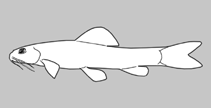
Homatula laxiclathra is similar to H. variegate, H. berezowskii, and H. longidorsalis in the shared presence of slender bodies with uniform depth [9.3–15.8% (mean 12.5) SL], a character distinguishing them from all remaining species of this genus where they have deeper bodies [13.6–23.9% (mean 16.6) SL] and their body depth evenly decreases posterior to the posterior end of the dorsal-fin base. The new species differs from H. variegata, H. berezowskii, and H. longidorsalis in having vertical brown bars on the caudal peduncle twice as wide as (vs. much narrower or slightly wider than) their interspaces. This new species, along with H. berezowskii, is further distinguished from H. variegata and H. longidorsalis by the presence of a shorter head (length 15.6–21.1% SL vs. 18.3–25.3), a shallower caudal peduncle (depth 8.4–11.4% SL vs. 9.6–13.6), a shorter adipose crest along the dorsal midline of the caudal peduncle anteriorly not extending to the midway of the analfin base (vs. extending beyond the vertical through the anal-fin origin), a scaleless (vs. partially scaled) predorsal body, and an intestine with (vs. without) a loop or bend behind the stomach. It is further distinct from H. berezowskii in having an oblique (vs. truncate) posterior margin of the caudal fin, and a narrower interorbital space [width 19.9–24.9 (average 22.5)% HL vs. 24.1–29.7 (average 27.0)]. The new species has an intestine with a loop anteriorly reaching the posterior surface of the U-shaped stomach, whereas the other related species do not have a loop at this portion of the intestine (Ref. 88693).
Body shape (shape guide): elongated.
Κύκλος ζωής και συμπεριφορά ζευγαρώματος
Γεννητική Ωρίμανση | Αναπαραγωγή | Γεννοβολία | Αβγά | Γονιμότητα | Προνύμφες
Gu, J.-H. and E. Zhang, 2012. Homatula laxiclathra (Teleostei: Balitoridae), a new species of nemacheiline loach from the Yellow River drainagein Shaanxi Province, northern China. Environ. Biol. Fishes 94:591-599. (Ref. 88693)
Κατάσταση Κόκκινου Καταλόγου IUCN (Ref. 130435: Version 2025-2 (Global))
Απειλή για τον άνθρωπο
Harmless
Ανθρώπινες χρήσεις
Εργαλεία
Ειδικές εκθέσεις
Λήψη XML
Διαδικτυακές πηγές
Εκτιμήσεις βάσει μοντέλων
Δείκτης φυλογενετικής ποικιλότητας (Αναφ.
82804): PD
50 = 0.5000 [Uniqueness, from 0.5 = low to 2.0 = high].
Bayesian length-weight: a=0.00724 (0.00352 - 0.01491), b=3.01 (2.84 - 3.18), in cm total length, based on LWR estimates for this (Sub)family-body shape (Ref.
93245).
Τροφικό Επίπεδο (Αναφ.
69278): 2.7 ±0.3 se; based on size and trophs of closest relatives
Ελαστικότητα (Αναφ.
120179): Μεσαίο(α), ελάχιστος χρόνος για διπλασιασμό πληθυσμού 1,4 - 4,4 έτη (Preliminary K or Fecundity.).
Ευπάθεια στην αλιεία (Ref.
59153): Low vulnerability (10 of 100).
🛈