التصنيف / الأسماء
الأسماء الشائعة | مرادفات | Catalog of Fishes(جنس, الانواع) | ITIS | CoL | WoRMS | Cloffa
>
Cypriniformes (Carps) >
Nemacheilidae (Brook loaches)
Etymology: Homatula: Greek, homos, homoios = similar + Greek, atylos, atylotos = without callosities; laxiclathra: Name from the combination of Latin words laxus (wide) and clathrus (barred), alluding the presence of wider vertical bars on each side of body; an adjective.
البيئة: الوسط / المنطقة المناخية / نطاق العمق / نطاق التوزيع
البيئة
; المياه العذبة القاع. Subtropical
Asia: China.
الحجم / وزن / العمر
النضج: Lm ? range ? - ? cm
Max length : 13.7 cm SL ذكر/ مختلط الجنس; (Ref. 88693)
وصف مختصر
مفاتيح التعريف | الوصف الخارجي | قياسات المظهر الخارجي
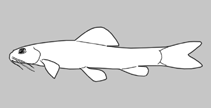
Homatula laxiclathra is similar to H. variegate, H. berezowskii, and H. longidorsalis in the shared presence of slender bodies with uniform depth [9.3–15.8% (mean 12.5) SL], a character distinguishing them from all remaining species of this genus where they have deeper bodies [13.6–23.9% (mean 16.6) SL] and their body depth evenly decreases posterior to the posterior end of the dorsal-fin base. The new species differs from H. variegata, H. berezowskii, and H. longidorsalis in having vertical brown bars on the caudal peduncle twice as wide as (vs. much narrower or slightly wider than) their interspaces. This new species, along with H. berezowskii, is further distinguished from H. variegata and H. longidorsalis by the presence of a shorter head (length 15.6–21.1% SL vs. 18.3–25.3), a shallower caudal peduncle (depth 8.4–11.4% SL vs. 9.6–13.6), a shorter adipose crest along the dorsal midline of the caudal peduncle anteriorly not extending to the midway of the analfin base (vs. extending beyond the vertical through the anal-fin origin), a scaleless (vs. partially scaled) predorsal body, and an intestine with (vs. without) a loop or bend behind the stomach. It is further distinct from H. berezowskii in having an oblique (vs. truncate) posterior margin of the caudal fin, and a narrower interorbital space [width 19.9–24.9 (average 22.5)% HL vs. 24.1–29.7 (average 27.0)]. The new species has an intestine with a loop anteriorly reaching the posterior surface of the U-shaped stomach, whereas the other related species do not have a loop at this portion of the intestine (Ref. 88693).
Body shape (shape guide): elongated.
دورة الحياة وسلوك التزاوج
النضج | التكاثر | وضع البيض | بيض | الخصوبة | اليرقات
Gu, J.-H. and E. Zhang, 2012. Homatula laxiclathra (Teleostei: Balitoridae), a new species of nemacheiline loach from the Yellow River drainagein Shaanxi Province, northern China. Environ. Biol. Fishes 94:591-599. (Ref. 88693)
حالة القائمة الحمراء للاتحاد الدولي لحفظ الطبيعة والموارد الطبيعية (Ref. 130435: Version 2025-2 (Global))
استخدامات بشرية
أدوات
تقارير خاصة
تنزيل XML
مصادر علي الأنترنت
تقديرات تستند إلى النماذج
مؤشر التنوع الشُعبي الوراثي (مرجع
82804): PD
50 = 0.5000 [Uniqueness, from 0.5 = low to 2.0 = high].
Bayesian length-weight: a=0.00724 (0.00352 - 0.01491), b=3.01 (2.84 - 3.18), in cm total length, based on LWR estimates for this (Sub)family-body shape (Ref.
93245).
مستوى غذائي (مرجع
69278): 2.7 ±0.3 se; based on size and trophs of closest relatives
المرونه (مرجع
120179): وسيط, الحد الزمني الأدني لتضاعف عدد أفراد المجتمع 1.4-4.4 سنة (Preliminary K or Fecundity.).
ضعف الصيد (Ref.
59153): Low vulnerability (10 of 100).
🛈