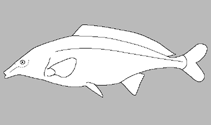
klasifikasi / Nama
Nama-nama umum | Sinonim (persamaan) | Catalog of Fishes(Marga, Jenis) | ITIS | CoL | WoRMS | Cloffa
>
Osteoglossiformes (Bony tongues) >
Mormyridae (Elephantfishes)
Etymology: Marcusenius: Becasue of J. Marcusen, author of "Zur Phauna des Schwarzen Meeres", 1867; ichthyologist; krameri: Marcusenius krameri is named for Prof. Bernd Kramer from the Zoological Institute of the University of Regensburg, Germany, in recognition of his contribution to the systematics of southern African mormyrids (Ref. 95448).
Eponymy: Dr Johann Andreas Marcusen (1817–1894) was a Latvian of German descent who was a physician, ichthyologist and zoologist. [...] Dr Leo Bernd Kramer is a German ichthyologist who was Professor at the Zoological Institute of the University of Regensburg, Germany until he retired (2009). [...] (Ref. 128868), visit book page.
Lingkungan: lingkungan / zona iklim / kisaran kedalaman / jangkauan distribusi
Ekologi
; air tawar bentopelagis. Tropical; 17°C - 27°C (Ref. 95448); 24°S - 25°S
Africa: Limpopo River and several of its tributaries in South Africa (Ref. 95448).
Ukuran / Berat / umur
Kematangan: Lm ? range ? - ? cm
Max length : 19.7 cm SL jantan/; (Ref. 95448)
deskripsi pendek
Kunci identifiaksi (pengenalan) | Morfologi | Morfometrik
Duri punggung (Keseluruhan (total)) : 0; duri punggung lunak (Keseluruhan (total)) : 22 - 25; Duri dubur: 0; Sirip dubur lunak: 28 - 31; vertebrata, bertulang belakang: 44. Diagnosis: Marcusenius krameri can be distinguished from its congeners by following characters: middle body depth 21.9-28.1% of standard length; distance from dorsal fin origin to end of caudal peduncle 39.9-41.7% of standard length; distance from anal fin origin to end of caudal peduncle 42.8-44.9% of standard length; dorsal fin length 15.5-20.0% of standard length; anal fin length 23.2-25.5% of standard length; depth of caudal peduncle 26.0-40.6% of its length; scales around caudal peduncle 16; total vertebrae 44; anterior gill rakers (5-6)+(5); total anterior gill rakers 10-11; posterior gill rakers (8)+(9); total posterior gill rakers 17; dorsal fin rays 22-25; anal fin rays 28-31; scales along lateral line 69-72; conical teeth on upper/lower jaws 4-6 (Ref. 95448).
Body shape (shape guide): elongated; Cross section: compressed.
Individuals of this species were found in groups; during the day they were commonly encountered below undercut river banks, especially in dense networks of tree roots or reed beds along the stream margins; places with shallow water and slow-flowing reaches of rivers and streams are especially attractive to them (Ref. 95448). Large numbers of small juveniles were found in bushes of aquatic reeds and floating grass on the periphery of the river or in side channels (Ref. 95448).
Siklus hidup dan perilaku kawin
Kematangan | Reproduksi, perkembang biakan | Pemijahan | telur-telur | Fekunditas | Larva
Maake, P.A., O. Gon and E.R. Swartz, 2014. Descriptions of three new species of Marcusenius Gill, 1862 (Teleostei: Mormyridae) from South Africa and Mozambique. Zootaxa 3780(3):455-480. (Ref. 95448)
Status IUCN Red List (Ref. 130435: Version 2025-2 (Global))
ancaman kepada manusia
Harmless
penggunaan manusia
Alat, peralatan
laporan khas
muat turun XML
Sumber internet
Estimasi berdasarkan model
Indeks keanekaragaman filogenetik (Acuan
82804): PD
50 = 0.5000 [Uniqueness, from 0.5 = low to 2.0 = high].
Bayesian length-weight: a=0.00562 (0.00248 - 0.01273), b=3.05 (2.85 - 3.25), in cm total length, based on LWR estimates for this (Sub)family-body shape (Ref.
93245).
Tingkat Trofik (Acuan
69278): 3.1 ±0.4 se; based on size and trophs of closest relatives
Daya lenting (Acuan
120179): Tinggi, Waktu penggandaan populasi minimum kurang dari 15 bulan (Preliminary K or Fecundity.).
Kerentanan Penangkapan Ikan (Ref.
59153): Low vulnerability (14 of 100).
🛈