Classification / Noms
Noms communs | Synonymes | Catalog of Fishes(Genre, Espèce) | ITIS | CoL | WoRMS | Cloffa
>
Osteoglossiformes (Bony tongues) >
Mormyridae (Elephantfishes)
Etymology: Marcusenius: Becasue of J. Marcusen, author of "Zur Phauna des Schwarzen Meeres", 1867; ichthyologist; krameri: Marcusenius krameri is named for Prof. Bernd Kramer from the Zoological Institute of the University of Regensburg, Germany, in recognition of his contribution to the systematics of southern African mormyrids (Ref. 95448).
Eponymy: Dr Johann Andreas Marcusen (1817–1894) was a Latvian of German descent who was a physician, ichthyologist and zoologist. [...] Dr Leo Bernd Kramer is a German ichthyologist who was Professor at the Zoological Institute of the University of Regensburg, Germany until he retired (2009). [...] (Ref. 128868), visit book page.
Environnement : milieu / zone climatique / profondeur / gamme de distribution
Écologie
; eau douce benthopélagique. Tropical; 17°C - 27°C (Ref. 95448); 24°S - 25°S
Africa: Limpopo River and several of its tributaries in South Africa (Ref. 95448).
Taille / Poids / Âge
Maturité: Lm ? range ? - ? cm
Max length : 19.7 cm SL mâle / non sexé; (Ref. 95448)
Description synthétique
Clés d'identification | Morphologie | Morphométrie
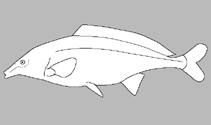
Épines dorsales (Total) : 0; Rayons mous dorsaux (Total) : 22 - 25; Épines anales: 0; Rayons mous anaux: 28 - 31; Vertèbres: 44. Diagnosis: Marcusenius krameri can be distinguished from its congeners by following characters: middle body depth 21.9-28.1% of standard length; distance from dorsal fin origin to end of caudal peduncle 39.9-41.7% of standard length; distance from anal fin origin to end of caudal peduncle 42.8-44.9% of standard length; dorsal fin length 15.5-20.0% of standard length; anal fin length 23.2-25.5% of standard length; depth of caudal peduncle 26.0-40.6% of its length; scales around caudal peduncle 16; total vertebrae 44; anterior gill rakers (5-6)+(5); total anterior gill rakers 10-11; posterior gill rakers (8)+(9); total posterior gill rakers 17; dorsal fin rays 22-25; anal fin rays 28-31; scales along lateral line 69-72; conical teeth on upper/lower jaws 4-6 (Ref. 95448).
Body shape (shape guide): elongated; Cross section: compressed.
Individuals of this species were found in groups; during the day they were commonly encountered below undercut river banks, especially in dense networks of tree roots or reed beds along the stream margins; places with shallow water and slow-flowing reaches of rivers and streams are especially attractive to them (Ref. 95448). Large numbers of small juveniles were found in bushes of aquatic reeds and floating grass on the periphery of the river or in side channels (Ref. 95448).
Cycle de vie et comportement reproducteur
Maturité | Reproduction | Frai | Œufs | Fécondité | Larves
Maake, P.A., O. Gon and E.R. Swartz, 2014. Descriptions of three new species of Marcusenius Gill, 1862 (Teleostei: Mormyridae) from South Africa and Mozambique. Zootaxa 3780(3):455-480. (Ref. 95448)
Statut dans la liste rouge de l'IUCN (Ref. 130435: Version 2025-2 (Global))
Menace pour l'homme
Harmless
Utilisations par l'homme
Outils
Articles particuliers
Télécharger en XML
Sources Internet
Estimations basées sur des modèles
Indice de diversité phylogénétique (Réf.
82804): PD
50 = 0.5000 [Uniqueness, from 0.5 = low to 2.0 = high].
Bayesian length-weight: a=0.00562 (0.00248 - 0.01273), b=3.05 (2.85 - 3.25), in cm total length, based on LWR estimates for this (Sub)family-body shape (Ref.
93245).
Niveau trophique (Réf.
69278): 3.1 ±0.4 se; based on size and trophs of closest relatives
Résilience (Réf.
120179): Haut, temps minimum de doublement de population inférieur à 15 mois (Preliminary K or Fecundity.).
Vulnérabilité de la pêche (Ref.
59153): Low vulnerability (14 of 100).
🛈