This website uses cookies to enhance your browsing experience and ensure the functionality of our site. For more detailed information about the types of cookies we use and how we protect your privacy, please visit our Privacy Information page.
×
Cookie Settings
This website uses different types of cookies to enhance your experience. Please select your preferences below:
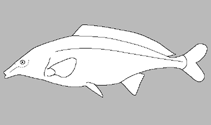
No image available for this species; drawing shows typical species in Mormyridae.
分類 / 名稱 俗名 | 同種異名 | Catalog of Fishes(屬, 種) | ITIS | CoL | WoRMS | Cloffa
Teleostei > Osteoglossiformes (Bony tongues) 骨舌魚目 (Bony tongues) > Mormyridae (Elephantfishes) 象鼻魚科 (Elephantfishes)
Etymology: Marcusenius:Becasue of J. Marcusen, author of "Zur Phauna des Schwarzen Meeres", 1867; ichthyologist; krameri:Marcusenius krameri is named for Prof. Bernd Kramer from the Zoological Institute of the University of Regensburg, Germany, in recognition of his contribution to the systematics of southern African mormyrids (Ref. 95448). Eponymy: Dr Johann Andreas Marcusen (1817–1894) was a Latvian of German descent who was a physician, ichthyologist and zoologist. [...] Dr Leo Bernd Kramer is a German ichthyologist who was Professor at the Zoological Institute of the University of Regensburg, Germany until he retired (2009). [...] (Ref. 128868), visit book page.
背棘 (總數) : 0; 背的軟條 (總數) : 22 - 25; 臀棘: 0; 臀鰭軟條: 28 - 31; 脊椎骨: 44. Diagnosis: Marcusenius krameri can be distinguished from its congeners by following characters: middle body depth 21.9-28.1% of standard length; distance from dorsal fin origin to end of caudal peduncle 39.9-41.7% of standard length; distance from anal fin origin to end of caudal peduncle 42.8-44.9% of standard length; dorsal fin length 15.5-20.0% of standard length; anal fin length 23.2-25.5% of standard length; depth of caudal peduncle 26.0-40.6% of its length; scales around caudal peduncle 16; total vertebrae 44; anterior gill rakers (5-6)+(5); total anterior gill rakers 10-11; posterior gill rakers (8)+(9); total posterior gill rakers 17; dorsal fin rays 22-25; anal fin rays 28-31; scales along lateral line 69-72; conical teeth on upper/lower jaws 4-6 (Ref. 95448).
Body shape (shape guide): elongated; Cross section: compressed.
Individuals of this species were found in groups; during the day they were commonly encountered below undercut river banks, especially in dense networks of tree roots or reed beds along the stream margins; places with shallow water and slow-flowing reaches of rivers and streams are especially attractive to them (Ref. 95448). Large numbers of small juveniles were found in bushes of aquatic reeds and floating grass on the periphery of the river or in side channels (Ref. 95448).
Maake, P.A., O. Gon and E.R. Swartz, 2014. Descriptions of three new species of Marcusenius Gill, 1862 (Teleostei: Mormyridae) from South Africa and Mozambique. Zootaxa 3780(3):455-480. (Ref. 95448)
系統發育多樣性指數 (參考文獻 82804): PD50 = 0.5000 [Uniqueness, from 0.5 = low to 2.0 = high].
Bayesian length-weight: a=0.00562 (0.00248 - 0.01273), b=3.05 (2.85 - 3.25), in cm total length, based on LWR estimates for this (Sub)family-body shape (Ref. 93245).
營養階層 (參考文獻 69278): 3.1 ±0.4 se; based on size and trophs of closest relatives
回復力 (參考文獻 120179): 高度, 族群倍增時間少於 15個月 (Preliminary K or Fecundity.).
釣魚的脆弱性 (Ref. 59153): Low vulnerability (14 of 100). 🛈