>
Acanthuriformes (Surgeonfishes) >
Ephippidae (Spadefishes, batfishes and scats)
Etymology: Zabidius: A term used by the Latin writer Martial with the meaning of "fell"; it is a personage to whom he wrote poems.
Environnement : milieu / zone climatique / profondeur / gamme de distribution
Écologie
marin récifal; profondeur 10 - 40 m (Ref. 90102). Tropical
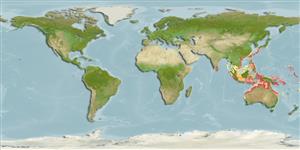
Indo-Pacific: Indonesia to northwestern Australia.
Taille / Poids / Âge
Maturité: Lm ? range ? - ? cm
Max length : 45.0 cm TL mâle / non sexé; (Ref. 3132); poids max. publié: 800.00 g (Ref. 3132)
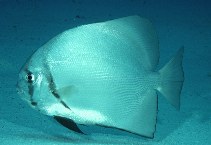
Épines dorsales (Total) : 9; Rayons mous dorsaux (Total) : 27 - 29; Épines anales: 3; Rayons mous anaux: 20 - 22. Silvery, with faint dark horizontal lines between scale rows. Brown band from top of head through eye to chest (fading with growth). Another, less distinct, curved dark bands from nape across operculum and pectoral-fin base to belly. Median fins dusky or pale with dark margins. Body orbicular and strongly compressed, its depth more than twice head length and 1.2 to 1.4 times in SL. Head length 3.1 to 3.6 times in SL. Head profile of adults with a slight bump between eyes. Snout, preopercle flange, and lower jaw naked, rest of head scaly. Jaws with 2 to 4 rows flattened, tricuspid teeth. Small patch of teeth on vomer. Palatines toothless. Five pores on each side of lower jaw. Preopercle with a few rudimentary serrae along its rounded angle. Opercle with a flat spine, and a rounded bone on its upper portion (Ref 43039).
Body shape (shape guide): short and / or deep.
Inhabits coastal reefs. Often occurs ion silt-sand bottoms of coastal trawling ground in 10-40 m (Ref. 90102).
Cycle de vie et comportement reproducteur
Maturité | Reproduction | Frai | Œufs | Fécondité | Larves
Allen, G.R. and R. Swainston, 1988. The marine fishes of north-western Australia: a field guide for anglers and divers. Western Australian Museum, Perth. 201 p. (Ref. 3132)
Statut dans la liste rouge de l'IUCN (Ref. 130435: Version 2025-2 (Global))
Menace pour l'homme
Harmless
Utilisations par l'homme
Outils
Articles particuliers
Télécharger en XML
Sources Internet
Estimations basées sur des modèles
Température préférée (Réf.
123201): 24.8 - 28.8, mean 27.8 °C (based on 234 cells).
Indice de diversité phylogénétique (Réf.
82804): PD
50 = 1.0000 [Uniqueness, from 0.5 = low to 2.0 = high].
Bayesian length-weight: a=0.02818 (0.01180 - 0.06734), b=2.94 (2.74 - 3.14), in cm total length, based on LWR estimates for this (Sub)family-body shape (Ref.
93245).
Niveau trophique (Réf.
69278): 3.5 ±0.4 se; based on size and trophs of closest relatives
Résilience (Réf.
120179): Milieu, temps minimum de doublement de population : 1,4 à 4,4 années (Preliminary K or Fecundity.).
Vulnérabilité de la pêche (Ref.
59153): Low to moderate vulnerability (35 of 100).
🛈
Nutriments (Ref.
124155): Calcium = 39.2 [19.0, 73.1] mg/100g; Iron = 0.488 [0.269, 0.806] mg/100g; Protein = 19.2 [18.0, 20.4] %; Omega3 = 0.116 [0.070, 0.189] g/100g; Selenium = 30.8 [16.9, 60.4] μg/100g; VitaminA = 61.3 [17.4, 206.8] μg/100g; Zinc = 0.792 [0.531, 1.168] mg/100g (wet weight);