>
Mulliformes (Goatfishes) >
Mullidae (Goatfishes)
Etymology: Parupeneus: Latin, parum, parvum = small + Peneus, the name of a river.
Eponymy: Dr Peter Forsskål (1732–1763) was a Swedish explorer, orientalist, naturalist and a student of Linnaeus. [...] (Ref. 128868), visit book page.
Milieu: milieu / Klimaatzone / Diepte / verspreidingsgebied
Ecologie
marien; brak water rifbewoner; diepte 1 - 45 m (Ref. 96856). Subtropical
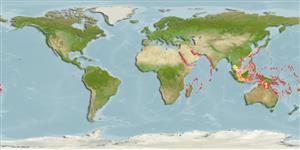
Indian Ocean: Red Sea into the Gulf of Aden and recorded from Socotra (Ref. 54393). Suez canal migrant and now established in the eastern Mediterranean.
Grootte / Gewicht / Leeftijd
Maturiteit: Lm ? range ? - ? cm
Max length : 28.0 cm TL mannelijk / geslacht onbekend; (Ref. 2272); common length : 25.0 cm TL mannelijk / geslacht onbekend; (Ref. 5450); max. gepubliceerd gewicht: 275.30 g (Ref. 121845)
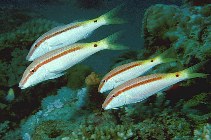
Dorsale stekels (totaal) : 8; Dorsale zachte stralen (totaal) : 9; Anale zachte stralen: 7. Diagnosis: Pectoral rays 14-17 (usually 16). Gill rakers 7-9 + 23-26 (total 30-34). Body relatively elongate, the depth 3.65-4.2 in SL; head length (HL) 2.9-3.25 in SL; snout length 1.7-1.9 in HL; barbel length 1.4-1.5 in HL; longest dorsal spine 1.5-1.7 in HL; penultimate dorsal ray 1.15-1.25 in length of last dorsal ray; pectoral-fin length 1.4-1.65 in HL; pelvic-fin length 1.4-1.6 in HL. A broad black stripe is present from side of upper lip through eye along upper side of body, ending beneath posterior part of second dorsal fin; body above stripe grayish green, the scale edges yellow; body below stripe white, the scale edges narrowly reddish; caudal peduncle yellow dorsally with an irregular roundish black spot, mostly above lateral line; caudal fin yellow; second dorsal and anal fins with narrow blue and yellow stripes; peritoneum pale (Ref. 54393).
Body shape (shape guide): fusiform / normal.
The most common goatfish in shallow water in the Red Sea. Usually found on sand bottoms near coral reefs (Ref. 3470). Feeds on invertebrates that live on sand (Ref. 13550).
Levenscyclus en paargedrag
Maturiteit | Voortplanting | Paaien | Eieren | Fecunditeit | Larven
Randall, J.E., 2004. Revision of the goatfish genus Parupeneus (Perciformes: Mullidae), with descriptions of two new species. Indo-Pac. Fish. (36):64 p. (Ref. 54393)
Status op de Rode Lijst van het IUCN (Ref. 130435: Version 2025-2 (Global))
Gevaar voor de mens
Harmless
Gebruik door de mens
Visserij: van minder commercieel belang; Aquarium: Commercieel
Tools
Speciale rapporten
Download XML
Internetbronnen
Schattingen op basis van modellen
Gewenste temperatuur (Ref.
123201): 24.7 - 29.1, mean 27.7 °C (based on 910 cells).
Fylogenetische diversiteitsindex (Ref.
82804): PD
50 = 0.5000 [Uniqueness, from 0.5 = low to 2.0 = high].
Bayesian length-weight: a=0.00891 (0.00547 - 0.01451), b=3.07 (2.93 - 3.21), in cm total length, based on LWR estimates for this species & Genus-body shape (Ref.
93245).
Trofisch niveau (Ref.
69278): 3.5 ±0.3 se; based on diet studies.
Generation time: 2.9 ( na - na) years. Estimated as median ln(3)/K based on 2
growth studies.
Weerstandsvermogen (Ref.
120179): Hoog, minimale populatieverdubbelingstijd minder dan 15 maanden (K=0.3-1.1).
Kwetsbaarheid van de visserij (Ref.
59153): Low vulnerability (15 of 100).
🛈
Voedingsstoffen (Ref.
124155): Calcium = 34.3 [13.2, 92.9] mg/100g; Iron = 0.415 [0.184, 1.045] mg/100g; Protein = 19 [16, 22] %; Omega3 = 0.215 [0.096, 0.490] g/100g; Selenium = 26.9 [10.2, 87.2] μg/100g; VitaminA = 67.9 [9.7, 507.8] μg/100g; Zinc = 0.483 [0.255, 0.980] mg/100g (wet weight);