>
Mulliformes (Goatfishes) >
Mullidae (Goatfishes)
Etymology: Parupeneus: Latin, parum, parvum = small + Peneus, the name of a river.
Eponymy: Dr Peter Forsskål (1732–1763) was a Swedish explorer, orientalist, naturalist and a student of Linnaeus. [...] (Ref. 128868), visit book page.
Environnement : milieu / zone climatique / profondeur / gamme de distribution
Écologie
marin; saumâtre récifal; profondeur 1 - 45 m (Ref. 96856). Subtropical
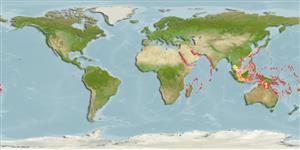
Indian Ocean: Red Sea into the Gulf of Aden and recorded from Socotra (Ref. 54393). Suez canal migrant and now established in the eastern Mediterranean.
Taille / Poids / Âge
Maturité: Lm ? range ? - ? cm
Max length : 28.0 cm TL mâle / non sexé; (Ref. 2272); common length : 25.0 cm TL mâle / non sexé; (Ref. 5450); poids max. publié: 275.30 g (Ref. 121845)
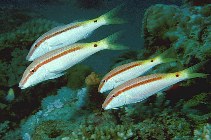
Épines dorsales (Total) : 8; Rayons mous dorsaux (Total) : 9; Rayons mous anaux: 7. Diagnosis: Pectoral rays 14-17 (usually 16). Gill rakers 7-9 + 23-26 (total 30-34). Body relatively elongate, the depth 3.65-4.2 in SL; head length (HL) 2.9-3.25 in SL; snout length 1.7-1.9 in HL; barbel length 1.4-1.5 in HL; longest dorsal spine 1.5-1.7 in HL; penultimate dorsal ray 1.15-1.25 in length of last dorsal ray; pectoral-fin length 1.4-1.65 in HL; pelvic-fin length 1.4-1.6 in HL. A broad black stripe is present from side of upper lip through eye along upper side of body, ending beneath posterior part of second dorsal fin; body above stripe grayish green, the scale edges yellow; body below stripe white, the scale edges narrowly reddish; caudal peduncle yellow dorsally with an irregular roundish black spot, mostly above lateral line; caudal fin yellow; second dorsal and anal fins with narrow blue and yellow stripes; peritoneum pale (Ref. 54393).
Body shape (shape guide): fusiform / normal.
The most common goatfish in shallow water in the Red Sea. Usually found on sand bottoms near coral reefs (Ref. 3470). Feeds on invertebrates that live on sand (Ref. 13550).
Cycle de vie et comportement reproducteur
Maturité | Reproduction | Frai | Œufs | Fécondité | Larves
Randall, J.E., 2004. Revision of the goatfish genus Parupeneus (Perciformes: Mullidae), with descriptions of two new species. Indo-Pac. Fish. (36):64 p. (Ref. 54393)
Statut dans la liste rouge de l'IUCN (Ref. 130435: Version 2025-2 (Global))
Menace pour l'homme
Harmless
Utilisations par l'homme
Pêcheries: intérêt commercial mineur; Aquarium: Commercial
Outils
Articles particuliers
Télécharger en XML
Sources Internet
Estimations basées sur des modèles
Température préférée (Réf.
123201): 24.7 - 29.1, mean 27.7 °C (based on 910 cells).
Indice de diversité phylogénétique (Réf.
82804): PD
50 = 0.5000 [Uniqueness, from 0.5 = low to 2.0 = high].
Bayesian length-weight: a=0.00891 (0.00547 - 0.01451), b=3.07 (2.93 - 3.21), in cm total length, based on LWR estimates for this species & Genus-body shape (Ref.
93245).
Niveau trophique (Réf.
69278): 3.5 ±0.3 se; based on diet studies.
Generation time: 2.9 ( na - na) years. Estimated as median ln(3)/K based on 2
growth studies.
Résilience (Réf.
120179): Haut, temps minimum de doublement de population inférieur à 15 mois (K=0.3-1.1).
Vulnérabilité de la pêche (Ref.
59153): Low vulnerability (15 of 100).
🛈
Nutriments (Ref.
124155): Calcium = 34.3 [13.2, 92.9] mg/100g; Iron = 0.415 [0.184, 1.045] mg/100g; Protein = 19 [16, 22] %; Omega3 = 0.215 [0.096, 0.490] g/100g; Selenium = 26.9 [10.2, 87.2] μg/100g; VitaminA = 67.9 [9.7, 507.8] μg/100g; Zinc = 0.483 [0.255, 0.980] mg/100g (wet weight);