Meio ambiente: milieu / Zona climática / intervalo de profundidade / faixa de distribuição
Ecologia
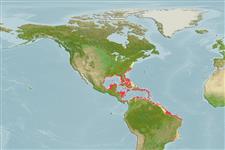
marinhas associadas(os) a recifes; não migratória (Ref. 52884); intervalo de profundidade 2 - 60 m (Ref. 9626). Tropical; 22°C - 28°C; 44°N - 23°S, 98°W - 34°W
Western Atlantic: New England, USA to the vicinity of Rio de Janeiro, Brazil, including the Gulf of Mexico and the Caribbean (Ref. 26938).
Comprimento de primeira maturação / Tamanho / Peso / Idade
Maturidade: Lm 22.6 range ? - ? cm
Max length : 60.0 cm TL macho/indeterminado; (Ref. 3797); common length : 45.0 cm TL macho/indeterminado; (Ref. 3797); peso máx. publicado: 1.8 kg (Ref. 40637)
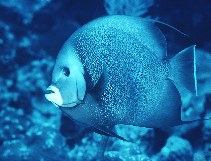
Espinhos dorsais (total) : 9; Raios dorsais (total) : 31 - 33; Espinhos anais: 3; Raios anais : 23 - 25. Pale gray around mouth, and pale gray margin on caudal fin. Inside of pectoral fin yellow (Ref. 26938). Juveniles are black with two light yellow bars on body and three on head; caudal fin yellow with a vertically elongate, nearly rectangular or hemispherical black spot in middle (Ref. 13442).
Body shape (shape guide): short and / or deep; Cross section: compressed.
Maximum depth from Ref. 126840. Common in coral reefs, usually solitary, occasionally in pairs. Juveniles are part-time cleaners. Feed mainly on sponges, but also takes tunicates, algae, zoantharians, gorgonians, hydroids, bryozoans, and seagrasses. Oviparous (Ref. 240). Monogamous and always in home-ranging pairs, that is they do not defend an exclusive territory (Ref. 52884). Flesh reported to be of excellent quality (Ref. 3797); marketed fresh and salted (Ref. 5217). Friendly toward divers (Ref. 9710). Have been reared in captivity (Ref. 35419).
Ciclo de vida ou comportamento de acasalamento
Maturidade | Reprodução | Desova | Ovos | Fecundidade | Larvas
Monogamous mating is observed as both facultative and social (Ref. 52884).
Allen, G.R., 1985. Butterfly and angelfishes of the world. Vol. 2. 3rd edit. in English. Mergus Publishers, Melle, Germany. (Ref. 4858)
Status na Lista Vermelha da UICN (Ref. 130435: Version 2025-2 (Global))
Ameaça para os humanos
Reports of ciguatera poisoning (Ref. 30303)
Uso pelos humanos
Pescarias: pouco comercial; Aquário: Espécies comerciais
Ferramentas
Relatórios especiais
Baixar XML
Fontes da internet
Estimativas baseadas em modelos
Temperatura preferida (Ref.
123201): 23.8 - 28.1, mean 27.3 °C (based on 849 cells).
Índice de diversidade filogenética (Ref.
82804): PD
50 = 0.5001 [Uniqueness, from 0.5 = low to 2.0 = high].
Bayesian length-weight: a=0.03020 (0.01542 - 0.05916), b=2.90 (2.73 - 3.07), in cm total length, based on LWR estimates for this species & Genus-body shape (Ref.
93245).
Nível Trófico (Ref.
69278): 3.2 ±0.1 se; based on diet studies.
Resiliência (Ref.
120179): Muito baixo(a), tempo mínimo de duplicação da população maior que 14 anos (Preliminary K or Fecundity.).
Vulnerabilidade da pesca (Ref.
59153): Moderate vulnerability (44 of 100).
🛈
Nutrientes (Ref.
124155): Calcium = 31.5 [15.9, 53.1] mg/100g; Iron = 0.459 [0.273, 0.748] mg/100g; Protein = 18.5 [17.3, 19.7] %; Omega3 = 0.085 [0.053, 0.137] g/100g; Selenium = 34.4 [17.3, 66.9] μg/100g; VitaminA = 54.3 [13.7, 197.7] μg/100g; Zinc = 1.1 [0.8, 1.6] mg/100g (wet weight);