>
Ovalentaria/misc (Various families in series Ovalentaria) >
Pomacentridae (Damselfishes) > Glyphisodontinae
Etymology: Abudefduf: Arabic, abu = father; this fish is the leader of the reef against other species (Ref. 45335).
More on author: Linnaeus.
Umwelt: Milieu / Klimazone / Tiefenbereich / Verbreitungsgebiet
Ökologie
seewasser riff-verbunden; standorttreu; tiefenbereich 0 - 20 m (Ref. 58047), usually ? - 10 m (Ref. 86997). Subtropical; 41°N - 37°S, 89°W - 14°E
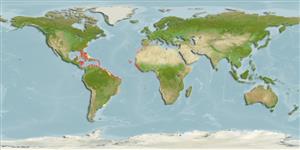
Atlantic Ocean: Canada (Ref. 5951) to Rhode Island, USA to Uruguay in the western Atlantic, abundant on Caribbean reefs; around islands of the mid-Atlantic, Cape Verde, and along the tropical coast of western Africa south to Angola. This species is strictly an Atlantic species. It is replaced in the Indo-Pacific region by the closely related Abudefduf vaigiensis (G. Allen, pers. comm.).
Länge bei der ersten Reifung / Größe / Gewicht / Alter
Geschlechtsreife: Lm 15.0, range 10 - ? cm
Max length : 22.9 cm TL Männchen/unbestimmt; (Ref. 26340); common length : 15.0 cm SL Männchen/unbestimmt; (Ref. 3139); max. veröff. Gewicht: 200.00 g (Ref. 5288)
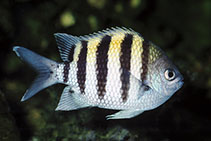
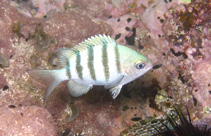
Rückenflossenstacheln (insgesamt) : 13; Rückenflossenweichstrahlen (insgesamt) : 12 - 13; Afterflossenstacheln: 2; Afterflossenweichstrahlen: 10 - 12. Greenish yellow above, shading to white below, with 5 prominent vertical black bars that narrow toward belly (Ref. 26938). A faint sixth bar may be present posteriorly on caudal peduncle; a black spot at upper base of pectoral fin. The adult male becomes dark bluish, the black bars thus less conspicuous on the body (Ref. 13442).
Body shape (shape guide): short and / or deep.
Juveniles are common in tide pools while adults are found over shallow reef tops. Adults frequently form large feeding aggregations of up to several hundred individuals. Food items include algae, small crustaceans and fish, and various invertebrate larvae (Ref. 3139). At Fernando de Noronha Archipelago, this species feeds on spinner dolphins’ feces and vomits. The offal feeding may be regarded as a simple behavioral shift from plankton feeding to drifting offal picking. Also, juveniles may hold cleaning stations together with the doctorfish (Acanthurus chirurgus) and the blue tang (Acanthurus coeruleus) and graze algae as well as pick molted skin and parasites from green turtles (Chelonia mydas ). This behavior is preceded by a characteristic inspection usually followed by feeding nips on the turtles’ skin (head, limbs, and tail), as well as on the carapace. The most inspected and cleaned body parts are the flippers (Ref. 48727, 51385). Adult males adopt a bluish ground color when guarding eggs. Oviparous, distinct pairing during breeding (Ref. 205). Eggs are demersal and adhere to the substrate (Ref. 205). Attracted to divers who feed fish. Marketed fresh (Ref. 3139). Has been reared in captivity (Ref. 35420).
Oviparous, distinct pairing during breeding (Ref. 205). Eggs are demersal and adhere to the substrate (Ref. 205). Males guard and aerate the eggs (Ref. 205).
Allen, G.R., 1991. Damselfishes of the world. Mergus Publishers, Melle, Germany. 271 p. (Ref. 7247)
IUCN Rote Liste Status (Ref. 130435: Version 2025-2 (Global))
Bedrohung für Menschen
Harmless
Nutzung durch Menschen
Fischereien: weniger kommerziell; Aquarium: Kommerziell
Tools
Zusatzinformationen
Download XML
Internet Quellen
Schätzungen auf der Grundlage von Modellen
Bevorzugte Temperatur (Ref.
123201): 19.9 - 28.1, mean 27.3 °C (based on 1025 cells).
Phylogenetischer Diversitätsindex (Ref.
82804): PD
50 = 0.5000 [Uniqueness, from 0.5 = low to 2.0 = high].
Bayesian length-weight: a=0.01778 (0.01107 - 0.02856), b=3.08 (2.95 - 3.21), in cm total length, based on LWR estimates for this species & Genus-body shape (Ref.
93245).
Trophische Ebene (Ref.
69278): 3.8 ±0.2 se; based on diet studies.
Widerstandsfähigkeit (Ref.
120179): mittel, Verdopplung der Population dauert 1,4 - 4,4 Jahre. (Preliminary K or Fecundity.).
Anfälligkeit der Fischerei (Ref.
59153): Low vulnerability (13 of 100).
🛈
Nährstoffe (Ref.
124155): Calcium = 40.4 [17.7, 89.9] mg/100g; Iron = 0.575 [0.306, 1.039] mg/100g; Protein = 19.5 [18.3, 20.6] %; Omega3 = 0.169 [0.094, 0.303] g/100g; Selenium = 11 [5, 24] μg/100g; VitaminA = 51.7 [13.4, 199.9] μg/100g; Zinc = 0.773 [0.478, 1.202] mg/100g (wet weight);