>
Ovalentaria/misc (Various families in series Ovalentaria) >
Pomacentridae (Damselfishes) > Microspathodontinae
Etymology: Microspathodon: Greek, mikros = small + Greek, spatha = spathe + Greek, odous = teeth (Ref. 45335).
More on author: Cuvier.
Ambiente: milieu / zona climatica / distribuzione batimetrica / gamma di distribuzione
Ecologia
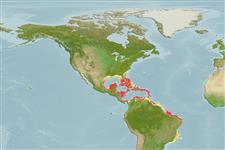
marino associati a barriera corallina; non migratori; distribuzione batimetrica 0 - 120 m (Ref. 10797), usually 0 - 10 m (Ref. 7247). Subtropical; 33°N - 25°S, 98°W - 34°W
Western Atlantic: southern Florida (USA) and Bermuda through the Caribbean Sea to Brazil (Ref. 40101).
Dimensione / Peso / Età
Maturità: Lm ? range ? - ? cm
Max length : 21.0 cm TL maschio/sesso non determinato; (Ref. 9710); common length : 15.0 cm TL maschio/sesso non determinato; (Ref. 3139)
Breve descrizione
Chiavi di identificazione | Morfologia | Morfometria
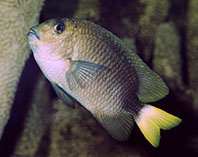
Spine dorsali (totale) : 12; Raggi dorsali molli (totale) : 14 - 15; Spine anali: 2; Raggi anali molli: 12 - 13. Tail bright yellow. Juveniles dark blue with transparent tail and electric blue spots on side (Ref. 26938). Adults dark yellowish brown, the edges of the scales darker (Ref 13442).
Body shape (shape guide): short and / or deep; Cross section: compressed.
A common (Ref. 9710) territorial species that inhabits coral reefs, juveniles usually encountered among branches of yellow stinging coral, Millepora. Adults are found in very shallow waters of coral reefs, usually near top of outer edge where there are caves, holes, and abundant fire coral (Ref. 26938). Feed primarily on algae but also on polyps of fire coral (Ref. 3139) and other invertebrate animal material (Ref. 13442). Juveniles occasionally pick parasites from other species of fish (Ref. 3139). Oviparous, distinct pairing during breeding (Ref. 205). Eggs are demersal and adhere to the substrate (Ref. 205). Males guard and aerate the eggs (Ref. 205). Occasionally marketed fresh (Ref. 3139). Have been reared in captivity (Ref. 35420).
Ciclo vitale e comportamento di accoppiamento
Maturità | Riproduzione | Deposizione | Uova | Fecondità | Larve
Oviparous, distinct pairing during breeding (Ref. 205). Eggs are demersal and adhere to the substrate (Ref. 205). Males guard and aerate the eggs (Ref. 205).
Allen, G.R., 1991. Damselfishes of the world. Mergus Publishers, Melle, Germany. 271 p. (Ref. 7247)
Stato della Lista Rossa IUCN (Ref. 130435: Version 2025-2 (Global))
Minaccia per l'uomo
Harmless
Usi umani
Pesca: pesca di sussistenza; Acquario: Commerciale
Strumenti
Rapporti speciali
Scarica XML
Fonti Internet
Stime basate su modelli
Temperatura preferita (Fonte Biblio.
123201): 26.1 - 28.2, mean 27.5 °C (based on 702 cells).
Indice di diversità filogenetica (Fonte Biblio.
82804): PD
50 = 0.5625 [Uniqueness, from 0.5 = low to 2.0 = high].
Bayesian length-weight: a=0.02239 (0.01251 - 0.04007), b=3.02 (2.86 - 3.18), in cm total length, based on LWR estimates for this species & (Sub)family-body (Ref.
93245).
Livello trofico (Fonte Biblio.
69278): 2.1 ±0.1 se; based on diet studies.
Resilienza (Fonte Biblio.
120179): Medio, tempo minimo di raddoppiamento della popolazione 1.4 - 4.4 anni (Preliminary K or Fecundity.).
Vulnerabilità della pesca (Ref.
59153): Low vulnerability (11 of 100).
🛈
Nutrienti (Ref.
124155): Calcium = 44.9 [18.7, 74.8] mg/100g; Iron = 0.645 [0.367, 1.193] mg/100g; Protein = 18.7 [17.4, 19.9] %; Omega3 = 0.166 [0.091, 0.301] g/100g; Selenium = 17.6 [8.0, 37.8] μg/100g; VitaminA = 37.2 [7.7, 166.9] μg/100g; Zinc = 1.07 [0.66, 1.70] mg/100g (wet weight);