>
Ovalentaria/misc (Various families in series Ovalentaria) >
Pomacentridae (Damselfishes) > Microspathodontinae
Etymology: Microspathodon: Greek, mikros = small + Greek, spatha = spathe + Greek, odous = teeth (Ref. 45335).
More on author: Cuvier.
Miljö: miljö / Klimatzon / djupintervall / distributionsområde
Ekologi
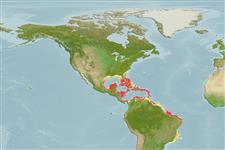
marina revassocierade; ej vandrande; djupintervall 0 - 120 m (Ref. 10797), usually 0 - 10 m (Ref. 7247). Subtropical; 33°N - 25°S, 98°W - 34°W
Western Atlantic: southern Florida (USA) and Bermuda through the Caribbean Sea to Brazil (Ref. 40101).
Storlek / Vikt / Ålder
Könsmognad: Lm ? range ? - ? cm
Max length : 21.0 cm TL hane/ej könsbestämd; (Ref. 9710); common length : 15.0 cm TL hane/ej könsbestämd; (Ref. 3139)
Kort beskrivning
Bestämningsnycklar | Morfologi | Morfometri
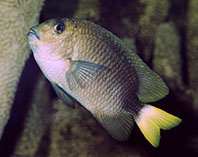
Taggstrålar i ryggfenan (totalt) : 12; Mjukstrålar i ryggfenan (totalt) : 14 - 15; Taggstrålar i analfenan: 2; Mjukstrålar i analfenan: 12 - 13. Tail bright yellow. Juveniles dark blue with transparent tail and electric blue spots on side (Ref. 26938). Adults dark yellowish brown, the edges of the scales darker (Ref 13442).
Body shape (shape guide): short and / or deep; Cross section: compressed.
A common (Ref. 9710) territorial species that inhabits coral reefs, juveniles usually encountered among branches of yellow stinging coral, Millepora. Adults are found in very shallow waters of coral reefs, usually near top of outer edge where there are caves, holes, and abundant fire coral (Ref. 26938). Feed primarily on algae but also on polyps of fire coral (Ref. 3139) and other invertebrate animal material (Ref. 13442). Juveniles occasionally pick parasites from other species of fish (Ref. 3139). Oviparous, distinct pairing during breeding (Ref. 205). Eggs are demersal and adhere to the substrate (Ref. 205). Males guard and aerate the eggs (Ref. 205). Occasionally marketed fresh (Ref. 3139). Have been reared in captivity (Ref. 35420).
Livscykel och parningsbeteende
Könsmognad | Reproduktion | Lek | Ägg | Fekunditet | Larver
Oviparous, distinct pairing during breeding (Ref. 205). Eggs are demersal and adhere to the substrate (Ref. 205). Males guard and aerate the eggs (Ref. 205).
Allen, G.R., 1991. Damselfishes of the world. Mergus Publishers, Melle, Germany. 271 p. (Ref. 7247)
Status på IUCN:s rödlista (Ref. 130435: Version 2025-2 (Global))
Hot mot människor
Harmless
Mänskliga användningsområden
Fiskeri: husbehovsfiske; Akvarium: Kommersiell
Verktyg
Särskilda rapporter
Ladda ner XML
Internet-källor
Uppskattningar baserade på modeller
Önskad temperatur (Ref.
123201): 26.1 - 28.2, mean 27.5 °C (based on 702 cells).
Index för fylogenetisk mångfald (Ref.
82804): PD
50 = 0.5625 [Uniqueness, from 0.5 = low to 2.0 = high].
Bayesian length-weight: a=0.02239 (0.01251 - 0.04007), b=3.02 (2.86 - 3.18), in cm total length, based on LWR estimates for this species & (Sub)family-body (Ref.
93245).
Trofisk nivå (Ref.
69278): 2.1 ±0.1 se; based on diet studies.
Resiliens (Ref.
120179): Mellan, lägsta populationsfördubblingstid 1,4-4,4 år (Preliminary K or Fecundity.).
Sårbarhet i fisket (Ref.
59153): Low vulnerability (11 of 100).
🛈
Näringsämnen (Ref.
124155): Calcium = 44.9 [18.7, 74.8] mg/100g; Iron = 0.645 [0.367, 1.193] mg/100g; Protein = 18.7 [17.4, 19.9] %; Omega3 = 0.166 [0.091, 0.301] g/100g; Selenium = 17.6 [8.0, 37.8] μg/100g; VitaminA = 37.2 [7.7, 166.9] μg/100g; Zinc = 1.07 [0.66, 1.70] mg/100g (wet weight);