>
Characiformes (Characins) >
Distichodontidae (Distichodus)
Etymology: Nannocharax: Latin, nannus = small + Greek, charax = a marine fish without identification (Ref. 45335); luapulae: Specific name, luapulae, is named after the Luapula River, from which the holotype was collected (Ref. 129519).
More on author: Boulenger.
Umwelt: Milieu / Klimazone / Tiefenbereich / Verbreitungsgebiet
Ökologie
; süßwasser pelagisch; pH range: 6.8 - 6.8. Tropical; 19°C - 19°C (Ref. 129519)
Africa: restricted ot Bangweulu-Mweru ecoregion in Democratic Republic of the Congo and Zambia (Ref. 95585, 129519), including Luapula River (Ref. 42540, 129519). Its occurrence in Upper Lualaba River (Ref. 2970) and lower Lufira River is not confirmed (Ref. 129519).
Größe / Gewicht / Alter
Geschlechtsreife: Lm ? range ? - ? cm
Max length : 4.6 cm TL Männchen/unbestimmt; (Ref. 129519)
Kurzbeschreibung
Bestimmungsschlüssel | Morphologie | Morphometrie
Rückenflossenstacheln (insgesamt) : 0; Rückenflossenweichstrahlen (insgesamt) : 12 - 13; Afterflossenstacheln: 0; Afterflossenweichstrahlen: 8; Wirbelzahl: 39. Diagnosis: Nannocharax luapulae can be distinguished from all its congeners by the following unique combination of characters: its body colouration, which consist of 8 to 10 vertically ovoid or rounded black blotches that overlie a longitudinal mid-lateral black stripe vs. largely unpigmented body with only a black spot at the base of the caudal fin in N. hastatus, N. maculicauda and N. ocellicauda, six or seven rounded, well-spaced, mid-lateral black spots in N. gracilis, 17 black bars in N. fasciolaris, a broad black longitudinal band running on flanks along two rows of scales in N. latifasciatus, or a thin black lateral band covering only the lateral line scales, extending from snout to median rays of caudal fin in N. taenia; a completely pored lateral line vs. incompletely pored in N. angolensis, N. dageti, N. lineostriatus, N. machadoi, N. minutus, N. monardi, N. multifasciatus, N. rubensteini, N. uniocellatus and N. wittei; 49-55 lateral line scales vs. 38-40 scales in N. altus, 40-45 scales in N. ansorgii, 37-40 scales in N. brevis, 38-42 scales in N. fasciatus, 37-43 scales in N. hadros, 42 scales in N. hollyi, 45-48 scales in N. macropterus, 36-37 scales in N. micros, 36 scales in N. ogoensis, 36-40 scales in N. parvus, 38-43 scales in N. procatopus, 38 scales in N. pteron, 46-48 scales in N. reidi, 46-48 scales in N. signifer, 38-39 scales in N. schoutedeni, 43-44 scales in N. seyboldi, 38-44 scales in N. usongo and 39-43 scales in N. zebra; and a dorsal-fin origin that is situated anterior, 1-2 lateral line scales, to the pelvic-fin origin vs. origin situated well behind the pelvic-fin origin in N. lineomaculatus, N. rubrolabiatus, or at the same level in N. elongatus, N. intermedius, N. niloticus and N. occidentalis (Ref. 129519). Nannocharax luapulae is most similar to N. chochamandai but can be distinguished from it by a low number of branched soft fin rays in dorsal and anal fins, 9-10 and 5 vs. 11-12 and 8-9; a high number of lateral ine scales, 49-55 vs. 41-46; a short pectoral fin, 18.3-20.6% of standard length, not reaching the pelvic-fin insertion but extending to the level of the anterior dorsal-fin base origin, vs. 21.6-28.4% of standard length, reaching the pelvic-fin insertion and the level of about the middle of the dorsal-fin base; a short pelvic fin, 20.0-22.9% of standard length, not reaching the anal-fin insertion but extending to about mid-level of the dorsal-adipose fin distance, vs. 24.3-30.6% of standard length, reaching the anal-fin insertion and the level of the last one fourth of the dorsal-adipose fin distance; and a short anal fin, 13.6-15.1% of standard length vs. 15.6-19.0% (Ref. 129519).
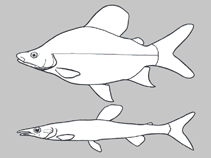
Body shape (shape guide): elongated.
Lebenszyklus und Paarungsverhalten
Geschlechtsreife | Fortpflanzung | Ablaichen | Eier | Fruchtbarkeit | Larven
Daget, J. and J.-P. Gosse, 1984. Distichodontidae. p. 184-211. In J. Daget, J.-P. Gosse and D.F.E. Thys van den Audenaerde (eds.) Check-list of the freshwater fishes of Africa (CLOFFA). ORSTOM, Paris and MRAC, Tervuren. Vol. 1. (Ref. 7094)
IUCN Rote Liste Status (Ref. 130435: Version 2025-2 (Global))
Bedrohung für Menschen
Harmless
Nutzung durch Menschen
Fischereien: kommerzielles potential
Tools
Zusatzinformationen
Download XML
Internet Quellen
Schätzungen auf der Grundlage von Modellen
Phylogenetischer Diversitätsindex (Ref.
82804): PD
50 = 0.5000 [Uniqueness, from 0.5 = low to 2.0 = high].
Bayesian length-weight: a=0.00447 (0.00186 - 0.01072), b=3.17 (2.97 - 3.37), in cm total length, based on LWR estimates for this (Sub)family-body shape (Ref.
93245).
Trophische Ebene (Ref.
69278): 3.1 ±0.4 se; based on size and trophs of closest relatives
Anfälligkeit der Fischerei (Ref.
59153): Low vulnerability (10 of 100).
🛈