>
Eupercaria/misc (Various families in series Eupercaria) >
Sciaenidae (Drums or croakers)
Etymology: Cynoscion: Greek, kyon = dog + Greek, odous = teeth + Greek, skion, skiaina = barbel, red mullet (Ref. 45335).
More on authors: Vaillant & Bocourt.
Ambiente: milieu / zona climatica / distribuzione batimetrica / gamma di distribuzione
Ecologia
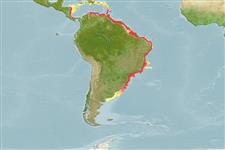
marino; salmastro demersale; distribuzione batimetrica 1 - 70 m (Ref. 9626), usually 18 - 55 m (Ref. 9626). Subtropical; 18°N - 52°S, 83°W - 34°W
Western Atlantic: Panama and the Greater Antilles to Argentina. Including Lesser Antilles (Ref. 26938). Also reported in Nicaragua (Ref. 13613).
Lunghezza alla prima maturità / Dimensione / Peso / Età
Maturità: Lm 25.1, range 15 - ? cm
Max length : 56.9 cm TL maschio/sesso non determinato; (Ref. 125970); common length : 35.0 cm TL maschio/sesso non determinato; (Ref. 3702); peso massimo pubblicato: 2.2 kg (Ref. 125970)
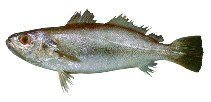
Spine dorsali (totale) : 11; Raggi dorsali molli (totale) : 23 - 27; Spine anali: 2; Raggi anali molli: 9. Colour greyish above, silvery below. Without conspicuous spots, but with faint dark streaks along scale rows above lateral line. Pectoral-fin bases and upper rays slightly dark, pelvic and anal fins often yellowish, dorsal and caudal fins dusky with darker margin. Inside opercle darkish visible externally. Mouth large, oblique, lower jaw slightly projecting. Upper jaw with a pair of large canine-like teeth at tip. Chin without barbel or pores, snout with only 2 marginal pores. Gas bladder with a pair of horn-like anterior appendages. Sagitta (large earstone) moderately broad and thick, Lapillus (small earstone rudimentary. Scales large. Soft portion of dorsal-fin base covered with small scales up to 1/2 of fin height (Ref 51721).
Body shape (shape guide): fusiform / normal.
Found over sand or mud bottoms from the coastline to about 60 m depth (Ref. 3702); rarely in waters with a depth of less than 18 m (Ref. 9626). Juveniles inhabit river estuaries (Ref. 3702). Oviparous, with high fecundity (Ref. 54358). Feed on fishes and crustaceans like crabs and shrimps (Ref. 35237). Important food fish (Ref. 3702).
Cervigón, F., 1993. Los peces marinos de Venezuela. Volume 2. Fundación Científica Los Roques, Caracas,Venezuela. 497 p. (Ref. 9626)
Stato della Lista Rossa IUCN (Ref. 130435: Version 2025-2 (Global))
Minaccia per l'uomo
Harmless
Usi umani
Pesca: commerciale; Pesce da pesca sportiva: si
Strumenti
Rapporti speciali
Scarica XML
Fonti Internet
Stime basate su modelli
Temperatura preferita (Fonte Biblio.
123201): 11.3 - 27.9, mean 22.4 °C (based on 376 cells).
Indice di diversità filogenetica (Fonte Biblio.
82804): PD
50 = 0.5000 [Uniqueness, from 0.5 = low to 2.0 = high].
Bayesian length-weight: a=0.00776 (0.00645 - 0.00934), b=3.06 (3.04 - 3.08), in cm total length, based on LWR estimates for this species (Ref.
93245).
Livello trofico (Fonte Biblio.
69278): 3.8 ±0.66 se; based on food items.
Resilienza (Fonte Biblio.
120179): Alto, tempo minimo di raddoppiamento della popolazione meno di 15 mesi (Fec = 47,000).
Prior r = 1.00, 95% CL = 0.66 - 1.50, Based on 1 data-limited stock assessment.
Vulnerabilità della pesca (Ref.
59153): Low to moderate vulnerability (32 of 100).
🛈
Nutrienti (Ref.
124155): Calcium = 79.3 [45.0, 151.5] mg/100g; Iron = 0.987 [0.527, 1.687] mg/100g; Protein = 19.1 [17.7, 20.8] %; Omega3 = 0.365 [0.220, 0.573] g/100g; Selenium = 25.1 [13.5, 47.9] μg/100g; VitaminA = 10.6 [3.9, 33.5] μg/100g; Zinc = 0.788 [0.575, 1.138] mg/100g (wet weight);