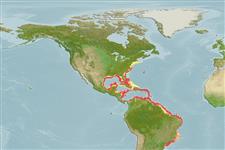
Entorno: milieu / zona climática / rango de profundidad / gama de distribución
Ecología
marino demersal; rango de profundidad 30 - 525 m (Ref. 5222), usually 100 - 200 m (Ref. 5222). Subtropical; 41°N - 27°S, 98°W - 34°W (Ref. 5222)
Western Atlantic: Canada (Ref. 5951) to Massachusetts, USA to southern Brazil, including the Gulf of Mexico and the Caribbean.
Longitud en la primera madurez / Tamaño / Peso / Edad
Madurez: Lm 54.0, range 47 - ? cm
Max length : 122 cm TL macho / no sexado; (Ref. 26340); common length : 60.0 cm TL macho / no sexado; (Ref. 5217); peso máximo publicado: 30.0 kg (Ref. 5222); edad máxima reportada: 27 años (Ref. 3090)
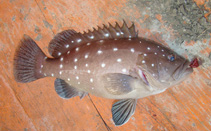
Espinas dorsales (total) : 11; Radios blandos dorsales (total) : 13 - 15; Espinas anales: 3; Radios blandos anales: 9. Distinguished by the following characteristics: Dark margin on spiny dorsal fin and dark saddle on caudal peduncle that extends below lateral line (Ref. 26938); juveniles with pale yellow caudal and pectoral fins; black saddle blotch on the caudal peduncle reaching below lateral line; depth of body contained 2.4-2.8 times in SL; head length 2.2-2.4 times in SL; convex interorbital area, width less than or subequal to eye diameter; enlarged serrae at angle of preopercle; distinctly convex upper edge of operculum; posterior nostrils 2-5 times larger than anterior nostrils (Ref. 89707).
Body shape (shape guide): fusiform / normal; Cross section: compressed.
Adults occur well offshore on rocky bottoms. Juveniles may be found inshore and are often reported from the northeastern coast of the U.S (Ref. 89707). Adults feed on fishes, gastropods, cephalopods, and brachyuran crustaceans (Ref. 5222). Valuable commercial food fish (Ref. 26938).
Ciclo vital y comportamiento de apareamiento
Madurez | Reproducción | Puesta | Huevos | Fecundidad | Larva
The size (76.7-109 cm) and age (8-29 yr) of 97 male specimens and the capture of two specimens undergoing sex change provided conclusive
evidence that snowy grouper are protogynous hermaphrodites (Ref. 45886).
Craig, M.T. and P.A. Hastings, 2007. A molecular phylogeny of the groupers of the subfamily Epinephelinae (Serranidae) with revised classification of the epinephelini. Ichthyol. Res. 54:1-17. (Ref. 83414)
Situación en la Lista Roja de la UICN (Ref. 130435: Version 2025-2 (Global))
Amenaza para el ser humano
Harmless
Usos humanos
Pesquerías: comercial; pesca deportiva: si
Herramientas
Informes especiales
Descargar XML
Fuentes de Internet
Estimaciones basadas en modelos
Temperatura preferida (Referencia
123201): 14.8 - 23.7, mean 19.5 °C (based on 93 cells).
Índice de diversidad filogenética (Referencia
82804): PD
50 = 0.5000 [Uniqueness, from 0.5 = low to 2.0 = high].
Bayesian length-weight: a=0.01549 (0.01194 - 0.02010), b=3.04 (3.01 - 3.07), in cm total length, based on LWR estimates for this species (Ref.
93245).
Nivel trófico (Referencia
69278): 4.0 ±0.58 se; based on food items.
Resiliencia (Referencia
120179): Bajo, población duplicada en un tiempo mínimo de 4.5-14 años (K=0.07-0.09; tmax=27).
Prior r = 0.17, 95% CL = 0.11 - 0.25, Based on 1 full stock assessment.
Vulnerabilidad pesquera (Ref.
59153): High vulnerability (64 of 100).
🛈
Vulnerabilidad climática (Ref.
125649): Moderate to high vulnerability (51 of 100).
🛈
Nutrientes (Ref.
124155): Calcium = 34.8 [15.4, 66.9] mg/100g; Iron = 0.74 [0.39, 1.39] mg/100g; Protein = 18.6 [16.8, 20.3] %; Omega3 = 0.382 [0.237, 0.648] g/100g; Selenium = 49.2 [25.6, 92.7] μg/100g; VitaminA = 9.2 [3.1, 31.1] μg/100g; Zinc = 0.511 [0.367, 0.752] mg/100g (wet weight);