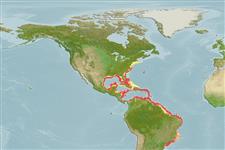
Miljö: miljö / Klimatzon / djupintervall / distributionsområde
Ekologi
marina bottenlevande; djupintervall 30 - 525 m (Ref. 5222), usually 100 - 200 m (Ref. 5222). Subtropical; 41°N - 27°S, 98°W - 34°W (Ref. 5222)
Western Atlantic: Canada (Ref. 5951) to Massachusetts, USA to southern Brazil, including the Gulf of Mexico and the Caribbean.
Längd vid första mognad / Storlek / Vikt / Ålder
Könsmognad: Lm 54.0, range 47 - ? cm
Max length : 122 cm TL hane/ej könsbestämd; (Ref. 26340); common length : 60.0 cm TL hane/ej könsbestämd; (Ref. 5217); publicerad maxvikt: 30.0 kg (Ref. 5222); rapporterad maxålder: 27 år (Ref. 3090)
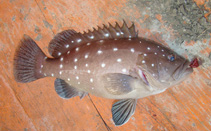
Taggstrålar i ryggfenan (totalt) : 11; Mjukstrålar i ryggfenan (totalt) : 13 - 15; Taggstrålar i analfenan: 3; Mjukstrålar i analfenan: 9. Distinguished by the following characteristics: Dark margin on spiny dorsal fin and dark saddle on caudal peduncle that extends below lateral line (Ref. 26938); juveniles with pale yellow caudal and pectoral fins; black saddle blotch on the caudal peduncle reaching below lateral line; depth of body contained 2.4-2.8 times in SL; head length 2.2-2.4 times in SL; convex interorbital area, width less than or subequal to eye diameter; enlarged serrae at angle of preopercle; distinctly convex upper edge of operculum; posterior nostrils 2-5 times larger than anterior nostrils (Ref. 89707).
Body shape (shape guide): fusiform / normal; Cross section: compressed.
Adults occur well offshore on rocky bottoms. Juveniles may be found inshore and are often reported from the northeastern coast of the U.S (Ref. 89707). Adults feed on fishes, gastropods, cephalopods, and brachyuran crustaceans (Ref. 5222). Valuable commercial food fish (Ref. 26938).
Livscykel och parningsbeteende
Könsmognad | Reproduktion | Lek | Ägg | Fekunditet | Larver
The size (76.7-109 cm) and age (8-29 yr) of 97 male specimens and the capture of two specimens undergoing sex change provided conclusive
evidence that snowy grouper are protogynous hermaphrodites (Ref. 45886).
Craig, M.T. and P.A. Hastings, 2007. A molecular phylogeny of the groupers of the subfamily Epinephelinae (Serranidae) with revised classification of the epinephelini. Ichthyol. Res. 54:1-17. (Ref. 83414)
Status på IUCN:s rödlista (Ref. 130435: Version 2025-2 (Global))
Sårbar (VU) (A2bd+4bd); Date assessed: 21 November 2016
Hot mot människor
Harmless
Mänskliga användningsområden
Fiskeri: kommersiell; sportfisk: ja
Verktyg
Särskilda rapporter
Ladda ner XML
Internet-källor
Uppskattningar baserade på modeller
Önskad temperatur (Ref.
123201): 14.8 - 23.7, mean 19.5 °C (based on 93 cells).
Index för fylogenetisk mångfald (Ref.
82804): PD
50 = 0.5000 [Uniqueness, from 0.5 = low to 2.0 = high].
Bayesian length-weight: a=0.01549 (0.01194 - 0.02010), b=3.04 (3.01 - 3.07), in cm total length, based on LWR estimates for this species (Ref.
93245).
Trofisk nivå (Ref.
69278): 4.0 ±0.58 se; based on food items.
Resiliens (Ref.
120179): Låg, lägsta populationsfördubblingstid 4,5-14 år (K=0.07-0.09; tmax=27).
Prior r = 0.17, 95% CL = 0.11 - 0.25, Based on 1 full stock assessment.
Sårbarhet i fisket (Ref.
59153): High vulnerability (64 of 100).
🛈
Sårbarhet för klimatet (Ref.
125649): Moderate to high vulnerability (51 of 100).
🛈
Näringsämnen (Ref.
124155): Calcium = 34.8 [15.4, 66.9] mg/100g; Iron = 0.74 [0.39, 1.39] mg/100g; Protein = 18.6 [16.8, 20.3] %; Omega3 = 0.382 [0.237, 0.648] g/100g; Selenium = 49.2 [25.6, 92.7] μg/100g; VitaminA = 9.2 [3.1, 31.1] μg/100g; Zinc = 0.511 [0.367, 0.752] mg/100g (wet weight);