>
Siluriformes (Catfishes) >
Plotosidae (Eeltail catfishes)
Etymology: Cnidoglanis: Greek, knide = nettle + Greek, glanis = a fish that can eat the bait without touching the hook; a cat fish (Ref. 45335).
More on author: Valenciennes.
Umwelt: Milieu / Klimazone / Tiefenbereich / Verbreitungsgebiet
Ökologie
seewasser; brackwasser demersal; tiefenbereich 1 - 30 m (Ref. 6390). Temperate; 28°S - 37°S
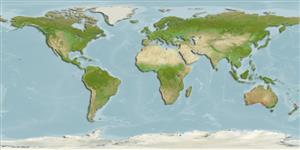
Indo-Pacific: endemic to Australia. Present along both eastern and western Australian coasts, from Kirra in southern Queensland to Jervis Bay in New South Wales, and from Kingston in South Australia to the Houtman Abrolhos in Western Australia. Distributional range extension to the Duck River in Tasmania (Ref. 7300) needs verification.
Länge bei der ersten Reifung / Größe / Gewicht / Alter
Geschlechtsreife: Lm ?, range 41 - ? cm
Max length : 91.0 cm SL Männchen/unbestimmt; (Ref. 33840); max. veröff. Gewicht: 2.5 kg (Ref. 6390); max. veröff. Alter: 13 Jahre (Ref. 6390)
Rückenflossenstacheln (insgesamt) : 1; Rückenflossenweichstrahlen (insgesamt) : 105 - 134; Afterflossenstacheln: 0; Afterflossenweichstrahlen: 95 - 112; Wirbelzahl: 77 - 78.
Body shape (shape guide): elongated.
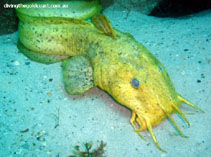
An inshore marine species which lives in shallow bays and sandy inlets near river mouths (Ref. 2156). Found most frequently over sand, rocks and weeds in clear to turbid waters. By day, cobblers are most often found in holes and on ledges in banks (Ref. 6390). They are opportunistic feeders, primarily feeding at night. Food consists of bivalve and univalve mollusks, crustaceans (small prawns and amphipods), polychaete worms, algae and organic debris (Ref. 26551). Juveniles eat more crustaceans, often from among drifting macrophytic algae (Ref. 26548). Adults feed mainly on mollusks and polychaetes (Ref. 6390). They are prey to birds such as cormorants and pelicans (Ref. 26548). Presence of sharp spines on the dorsal and pectoral fins can inflict painful wounds (Ref. 2156).
Males guard the eggs between their pelvic fins for an unknown period in the nest which the male have constructed. The drift weeds found in inshore marine waters, protected inshore marine environments and estuaries act as nursery areas. Cobbler enter these areas during their first year of life and often remain there for long periods (Refs. 26548, 26549).
Paxton, J.R., D.F. Hoese, G.R. Allen and J.E. Hanley, 1989. Pisces. Petromyzontidae to Carangidae. Zoological Catalogue of Australia, Vol. 7. Australian Government Publishing Service, Canberra, 665 p. (Ref. 7300)
IUCN Rote Liste Status (Ref. 130435: Version 2025-2 (Global))
Nutzung durch Menschen
Fischereien: weniger kommerziell; Sportfisch: ja
Tools
Zusatzinformationen
Download XML
Internet Quellen
Schätzungen auf der Grundlage von Modellen
Bevorzugte Temperatur (Ref.
123201): 16.8 - 22.3, mean 18.2 °C (based on 192 cells).
Phylogenetischer Diversitätsindex (Ref.
82804): PD
50 = 1.0000 [Uniqueness, from 0.5 = low to 2.0 = high].
Bayesian length-weight: a=0.00468 (0.00210 - 0.01040), b=3.06 (2.86 - 3.26), in cm total length, based on LWR estimates for this (Sub)family-body shape (Ref.
93245).
Trophische Ebene (Ref.
69278): 2.8 ±0.32 se; based on food items.
Generation time: 5.5 ( na - na) years. Estimated as median ln(3)/K based on 2
growth studies.
Widerstandsfähigkeit (Ref.
120179): mittel, Verdopplung der Population dauert 1,4 - 4,4 Jahre. (tm=2-3; tmax=13; Fec=300).
Anfälligkeit der Fischerei (Ref.
59153): Moderate to high vulnerability (54 of 100).
🛈
Nährstoffe (Ref.
124155): Calcium = 35.7 [16.7, 57.7] mg/100g; Iron = 0.342 [0.202, 0.584] mg/100g; Protein = 16.6 [14.7, 18.7] %; Omega3 = 0.351 [0.187, 0.639] g/100g; Selenium = 14.9 [7.3, 31.5] μg/100g; VitaminA = 7.42 [2.66, 21.37] μg/100g; Zinc = 0.641 [0.445, 0.923] mg/100g (wet weight);