>
Siluriformes (Catfishes) >
Plotosidae (Eeltail catfishes)
Etymology: Cnidoglanis: Greek, knide = nettle + Greek, glanis = a fish that can eat the bait without touching the hook; a cat fish (Ref. 45335).
More on author: Valenciennes.
Môi trường: môi trường / vùng khí hậu / Mức độ sâu / phạm vi phân phối
Sinh thái học
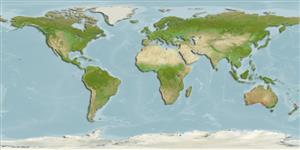
biển; thuộc về nước lợ gần đáy; mức độ sâu 1 - 30 m (Ref. 6390). Temperate; 28°S - 37°S
Indo-Pacific: endemic to Australia. Present along both eastern and western Australian coasts, from Kirra in southern Queensland to Jervis Bay in New South Wales, and from Kingston in South Australia to the Houtman Abrolhos in Western Australia. Distributional range extension to the Duck River in Tasmania (Ref. 7300) needs verification.
Chiều dài lúc trưởng thành đầu tiên / Bộ gần gũi / Khối lượng (Trọng lượng) / Tuổi
Chín muồi sinh dục: Lm ?, range 41 - ? cm
Max length : 91.0 cm SL con đực/không giới tính; (Ref. 33840); Khối lượng cực đại được công bố: 2.5 kg (Ref. 6390); Tuổi cực đại được báo cáo: 13 các năm (Ref. 6390)
Các tia vây lưng cứng (tổng cộng) : 1; Các vây lưng mềm (tổng cộng) : 105 - 134; Tia cứng vây hậu môn: 0; Tia mềm vây hậu môn: 95 - 112; Động vật có xương sống: 77 - 78.
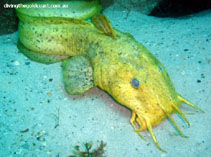
Body shape (shape guide): elongated.
An inshore marine species which lives in shallow bays and sandy inlets near river mouths (Ref. 2156). Found most frequently over sand, rocks and weeds in clear to turbid waters. By day, cobblers are most often found in holes and on ledges in banks (Ref. 6390). They are opportunistic feeders, primarily feeding at night. Food consists of bivalve and univalve mollusks, crustaceans (small prawns and amphipods), polychaete worms, algae and organic debris (Ref. 26551). Juveniles eat more crustaceans, often from among drifting macrophytic algae (Ref. 26548). Adults feed mainly on mollusks and polychaetes (Ref. 6390). They are prey to birds such as cormorants and pelicans (Ref. 26548). Presence of sharp spines on the dorsal and pectoral fins can inflict painful wounds (Ref. 2156).
Males guard the eggs between their pelvic fins for an unknown period in the nest which the male have constructed. The drift weeds found in inshore marine waters, protected inshore marine environments and estuaries act as nursery areas. Cobbler enter these areas during their first year of life and often remain there for long periods (Refs. 26548, 26549).
Paxton, J.R., D.F. Hoese, G.R. Allen and J.E. Hanley, 1989. Pisces. Petromyzontidae to Carangidae. Zoological Catalogue of Australia, Vol. 7. Australian Government Publishing Service, Canberra, 665 p. (Ref. 7300)
Tình trạng Sách đỏ IUCN (Ref. 130435: Version 2025-2 (Global))
Mối đe dọa đối với con người
Sử dụng của con người
Các nghề cá: buôn bán nhỏ; cá để chơi: đúng
Các công cụ
Báo cáo đặc biệt
Tải xuống XML
Các nguồn internet
Ước tính dựa trên mô hình
Nhiệt độ ưa thích (Tài liệu tham khảo
123201): 16.8 - 22.3, mean 18.2 °C (based on 192 cells).
Chỉ số đa dạng phát sinh loài (Tài liệu tham khảo
82804): PD
50 = 1.0000 [Uniqueness, from 0.5 = low to 2.0 = high].
Bayesian length-weight: a=0.00468 (0.00210 - 0.01040), b=3.06 (2.86 - 3.26), in cm total length, based on LWR estimates for this (Sub)family-body shape (Ref.
93245).
Mức dinh dưỡng (Tài liệu tham khảo
69278): 2.8 ±0.32 se; based on food items.
Generation time: 5.5 ( na - na) years. Estimated as median ln(3)/K based on 2
growth studies.
Thích nghi nhanh (Tài liệu tham khảo
120179): Trung bình, thời gian nhân đôi của chủng quần tối thiểu là 1.4 - 4.4 năm (tm=2-3; tmax=13; Fec=300).
Sự dễ bị tổn thương của nghề đánh cá (Ref.
59153): Moderate to high vulnerability (54 of 100).
🛈
Chất dinh dưỡng (Ref.
124155): Calcium = 35.7 [16.7, 57.7] mg/100g; Iron = 0.342 [0.202, 0.584] mg/100g; Protein = 16.6 [14.7, 18.7] %; Omega3 = 0.351 [0.187, 0.639] g/100g; Selenium = 14.9 [7.3, 31.5] μg/100g; VitaminA = 7.42 [2.66, 21.37] μg/100g; Zinc = 0.641 [0.445, 0.923] mg/100g (wet weight);