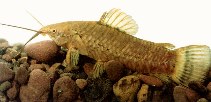
Taxonomic Remarks
See Reis (1997) for phylogeny and Reis (1998) for detailed description.
Milieu: milieu / Klimaatzone / Diepte / verspreidingsgebied
Ecologie
; zoet water demersaal; pH range: 6.0 - 8.0; dH range: 5 - 19. Tropical; 18°C - 28°C (Ref. 1672)
South America: Amazon and Orinoco River basins, as well as coastal rivers of the Guianas and northern Brazil.
Grootte / Gewicht / Leeftijd
Maturiteit: Lm ? range ? - ? cm
Max length : 17.0 cm SL mannelijk / geslacht onbekend; (Ref. 121647); max. gepubliceerd gewicht: 350.00 g (Ref. 27188)
Obligate air-breathing (Ref. 126274); Ubiquitous (Ref. 35381). Occurs in ponds (Ref. 11229), swamps and flooded savanna. May also occur in inland creeks with strong current. When the swamps are drained during the dry season, they burrow in the mud at a depth of 15-25 cm and remain there until the first rains. They hide only at the bottom of the marshes which remain always a little muddy even during the dry season. Today, they are presently captured with the net. Previously, fishermen drained the marshes in order to unearth the fish which had hidden there (Ref. 27188). Omnivore (Ref. 26543). Intestinal breathing, complementary to branchial breathing, enables them to adapt to extreme hypoxic conditions which occur in their biotopes. For these reasons, the relevant intestinal zone has a more reduced mucus epithelium as well as an increased blood system. In the dry season when swamps get dry, they sink deeper into the muddy substrate down to a depth of 20 cm. This way, they live at a slower pace, often in groups, until the next rainy season. At the end of October, the fishermen dig them up because they are appreciated for their flesh. At other times, they are fished with nets (Ref. 35381).
Levenscyclus en paargedrag
Maturiteit | Voortplanting | Paaien | Eieren | Fecunditeit | Larven
Male builds nests in shallow swamps or swamp forests during the rainy season.
Reis, R.E., P.-Y. Le Bail and J.H.A. Mol, 2005. New arrangement in the synonymy of Megalechis Reis, 1997 (Siluriformes: Callichthyidae). Copeia 2005(3):678-682. (Ref. 57766)
Status op de Rode Lijst van het IUCN (Ref. 130435: Version 2025-2 (Global))
Gevaar voor de mens
Harmless
Gebruik door de mens
Visserij: van minder commercieel belang; Aquarium: Commercieel
Tools
Speciale rapporten
Download XML
Internetbronnen
Schattingen op basis van modellen
Fylogenetische diversiteitsindex (Ref.
82804): PD
50 = 0.7500 [Uniqueness, from 0.5 = low to 2.0 = high].
Bayesian length-weight: a=0.02455 (0.01242 - 0.04852), b=2.96 (2.78 - 3.14), in cm total length, based on LWR estimates for this species & (Sub)family-body (Ref.
93245).
Trofisch niveau (Ref.
69278): 3.0 ±0.0 se; based on diet studies.
Weerstandsvermogen (Ref.
120179): Hoog, minimale populatieverdubbelingstijd minder dan 15 maanden (Preliminary K or Fecundity.).
Kwetsbaarheid van de visserij (Ref.
59153): Low vulnerability (11 of 100).
🛈