>
Blenniiformes (Blennies) >
Blenniidae (Combtooth blennies) > Salariinae
Etymology: Hypsoblennius: Greek, hypsi = high + Greek, blennios = mucus (Ref. 45335); invemar: Invemar (acronym) = in honor of the Instituto de Investigaciones Marinas de Punta Betin at Santa Marta, Colombia (Ref. 94455).
Environnement : milieu / zone climatique / profondeur / gamme de distribution
Écologie
marin démersal; profondeur 1 - 5 m. Tropical; 30°N - 9°N
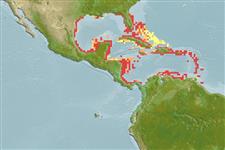
Western Atlantic: Louisiana, USA and the Gulf of Mexico (Ref. 13628) to Rio de Janeiro, Brazil (Ref. 57756).
Taille / Poids / Âge
Maturité: Lm ? range ? - ? cm
Max length : 5.8 cm TL mâle / non sexé; (Ref. 7251)
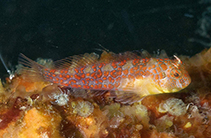
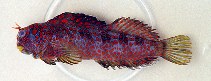
Épines dorsales (Total) : 12; Rayons mous dorsaux (Total) : 12; Épines anales: 2; Rayons mous anaux: 14. Head and usually pectoral fin base have orange spots on dark background. Black spot on side of head behind eye (Ref. 26938). Gill opening extending ventrally to below level of ventralmost pectoral-fin ray; segmented dorsal-fin rays 11 or 12; segmented pelvic-fin rays 4; last dorsal-fin spine 3.7 to 7.5% SL (Ref. 10696).
Body shape (shape guide): elongated.
Adults live in attached, empty barnacle shells in clear waters, usually on pilings, buoys and rock ledges at or near surface. Recorded from oil platforms. Oviparous. Eggs are demersal and adhesive (Ref. 205), and are attached to the substrate via a filamentous, adhesive pad or pedestal (Ref. 94114). Larvae are planktonic, often found in shallow, coastal waters (Ref. 94114).
Cycle de vie et comportement reproducteur
Maturité | Reproduction | Frai | Œufs | Fécondité | Larves
Oviparous, distinct pairing (Ref. 205).
Robins, C.R. and G.C. Ray, 1986. A field guide to Atlantic coast fishes of North America. Houghton Mifflin Company, Boston, U.S.A. 354 p. (Ref. 7251)
Statut dans la liste rouge de l'IUCN (Ref. 130435: Version 2025-2 (Global))
Menace pour l'homme
Harmless
Utilisations par l'homme
Outils
Articles particuliers
Télécharger en XML
Sources Internet
Estimations basées sur des modèles
Température préférée (Réf.
123201): 24 - 28.2, mean 27.1 °C (based on 416 cells).
Indice de diversité phylogénétique (Réf.
82804): PD
50 = 0.5000 [Uniqueness, from 0.5 = low to 2.0 = high].
Bayesian length-weight: a=0.00776 (0.00354 - 0.01702), b=3.00 (2.81 - 3.19), in cm total length, based on LWR estimates for this (Sub)family-body shape (Ref.
93245).
Niveau trophique (Réf.
69278): 2.9 ±0.2 se; based on size and trophs of closest relatives
Résilience (Réf.
120179): Haut, temps minimum de doublement de population inférieur à 15 mois (Preliminary K or Fecundity.).
Vulnérabilité de la pêche (Ref.
59153): Low vulnerability (10 of 100).
🛈
Nutriments (Ref.
124155): Calcium = 640 [371, 1,528] mg/100g; Iron = 1.96 [1.09, 3.53] mg/100g; Protein = 17.4 [16.3, 18.4] %; Omega3 = 0.141 [0.066, 0.294] g/100g; Selenium = 29.1 [12.9, 68.4] μg/100g; VitaminA = 36.5 [11.1, 125.9] μg/100g; Zinc = 2.95 [1.96, 4.39] mg/100g (wet weight);