>
Blenniiformes (Blennies) >
Blenniidae (Combtooth blennies) > Salariinae
Etymology: Hypsoblennius: Greek, hypsi = high + Greek, blennios = mucus (Ref. 45335); invemar: Invemar (acronym) = in honor of the Instituto de Investigaciones Marinas de Punta Betin at Santa Marta, Colombia (Ref. 94455).
Entorno: milieu / zona climática / rango de profundidad / gama de distribución
Ecología
marino demersal; rango de profundidad 1 - 5 m. Tropical; 30°N - 9°N
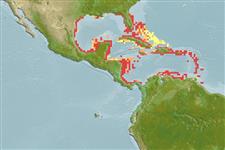
Western Atlantic: Louisiana, USA and the Gulf of Mexico (Ref. 13628) to Rio de Janeiro, Brazil (Ref. 57756).
Tamaño / Peso / Edad
Madurez: Lm ? range ? - ? cm
Max length : 5.8 cm TL macho / no sexado; (Ref. 7251)
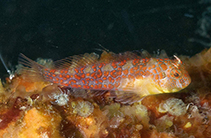
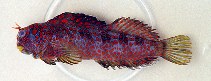
Espinas dorsales (total) : 12; Radios blandos dorsales (total) : 12; Espinas anales: 2; Radios blandos anales: 14. Head and usually pectoral fin base have orange spots on dark background. Black spot on side of head behind eye (Ref. 26938). Gill opening extending ventrally to below level of ventralmost pectoral-fin ray; segmented dorsal-fin rays 11 or 12; segmented pelvic-fin rays 4; last dorsal-fin spine 3.7 to 7.5% SL (Ref. 10696).
Body shape (shape guide): elongated.
Adults live in attached, empty barnacle shells in clear waters, usually on pilings, buoys and rock ledges at or near surface. Recorded from oil platforms. Oviparous. Eggs are demersal and adhesive (Ref. 205), and are attached to the substrate via a filamentous, adhesive pad or pedestal (Ref. 94114). Larvae are planktonic, often found in shallow, coastal waters (Ref. 94114).
Ciclo vital y comportamiento de apareamiento
Madurez | Reproducción | Puesta | Huevos | Fecundidad | Larva
Oviparous, distinct pairing (Ref. 205).
Robins, C.R. and G.C. Ray, 1986. A field guide to Atlantic coast fishes of North America. Houghton Mifflin Company, Boston, U.S.A. 354 p. (Ref. 7251)
Situación en la Lista Roja de la UICN (Ref. 130435: Version 2025-2 (Global))
Amenaza para el ser humano
Harmless
Usos humanos
Herramientas
Informes especiales
Descargar XML
Fuentes de Internet
Estimaciones basadas en modelos
Temperatura preferida (Referencia
123201): 24 - 28.2, mean 27.1 °C (based on 416 cells).
Índice de diversidad filogenética (Referencia
82804): PD
50 = 0.5000 [Uniqueness, from 0.5 = low to 2.0 = high].
Bayesian length-weight: a=0.00776 (0.00354 - 0.01702), b=3.00 (2.81 - 3.19), in cm total length, based on LWR estimates for this (Sub)family-body shape (Ref.
93245).
Nivel trófico (Referencia
69278): 2.9 ±0.2 se; based on size and trophs of closest relatives
Resiliencia (Referencia
120179): Alto, población duplicada en un tiempo mínimo inferior a 15 meses (Preliminary K or Fecundity.).
Vulnerabilidad pesquera (Ref.
59153): Low vulnerability (10 of 100).
🛈
Nutrientes (Ref.
124155): Calcium = 640 [371, 1,528] mg/100g; Iron = 1.96 [1.09, 3.53] mg/100g; Protein = 17.4 [16.3, 18.4] %; Omega3 = 0.141 [0.066, 0.294] g/100g; Selenium = 29.1 [12.9, 68.4] μg/100g; VitaminA = 36.5 [11.1, 125.9] μg/100g; Zinc = 2.95 [1.96, 4.39] mg/100g (wet weight);