>
Acanthuriformes (Surgeonfishes) >
Acanthuridae (Surgeonfishes, tangs, unicornfishes) > Acanthurinae
Etymology: Acanthurus: Greek, akantha = thorn + Greek, oura = tail (Ref. 45335).
More on author: Linnaeus.
Taxonomic Remarks
Planes and Fauvelot (2002) studied Acanthurus triostegus over its vast range and published in the journal Evolution and they did not recognize Acanthurus triostegus sandvicensis as a species. FishBase follows Randall, 1956 with A. sandvicensis as a subspecies (synonym) of A. triostegus.
Entorno: milieu / zona climática / rango de profundidad / gama de distribución
Ecología
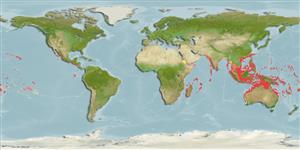
marino asociado a arrecife; rango de profundidad 0 - 90 m (Ref. 9710), usually 0 - 90 m (Ref. 27115). Tropical; 26°N - 36°S, 25°E - 85°W (Ref. 57245)
Indo-Pacific: throughout the region except for the seas around the Arabian Peninsula. Eastern Pacific: lower Gulf of California to Panama, including the Revillagigedo, Cocos, Clipperton, and Galapagos islands.
Longitud en la primera madurez / Tamaño / Peso / Edad
Madurez: Lm 8.8 range ? - ? cm
Max length : 27.0 cm TL macho / no sexado; (Ref. 3145); common length : 17.0 cm TL macho / no sexado; (Ref. 9267)
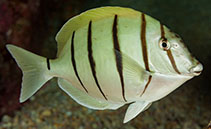
Espinas dorsales (total) : 9; Radios blandos dorsales (total) : 22 - 26; Espinas anales: 3; Radios blandos anales: 19 - 22. Body olivaceous gray, with 4 vertical stripes (1 stripe on head across the yellow eye; 1 on caudal peduncle); shading to white ventrally, often with a sharp line of demarcation. Sharp, forward-pointing, erectile spine on each side of caudal peduncle which folds down into a groove. Scales minute. Teeth with denticulations on sides and top. Gill rakers 18-22 in anterior row, 19-24 in posterior row.
Body shape (shape guide): short and / or deep; Cross section: compressed.
Adults occur in lagoon and seaward reefs with hard substrate; young abundant in tide pools (Ref. 3145, 48637). Benthopelagic (Ref. 58302). Often feeding near freshwater run-offs where certain algae grow on rocks that are grazed (Ref. 48637). Occasionally form schools; feed on filamentous algae in large aggregations. During spawning, clouds of eggs and sperm are preyed upon by eagle rays which are often present during spawning. Form spawning aggregations (Ref. 27825). Size of metamorphosis from post-larva stage to juvenile is 3.2 cm (Ref. 9267). Utilized as a food fish (Ref. 7364). Minimum depth reported taken from Ref. 27115.
Form spawning aggregations (Ref. 27825).
Randall, J.E., 1956. A revision of the surgeonfish genus Acanthurus. Pac. Sci. 10(2):159-235. (Ref. 1920)
Situación en la Lista Roja de la UICN (Ref. 130435: Version 2025-2 (Global))
Amenaza para el ser humano
Reports of ciguatera poisoning (Ref. 4690)
Usos humanos
Pesquerías: comercial; Acuario: Comercial
Herramientas
Informes especiales
Descargar XML
Fuentes de Internet
Estimaciones basadas en modelos
Temperatura preferida (Referencia
123201): 23.4 - 28.9, mean 27.6 °C (based on 2614 cells).
Índice de diversidad filogenética (Referencia
82804): PD
50 = 0.5000 [Uniqueness, from 0.5 = low to 2.0 = high].
Bayesian length-weight: a=0.02344 (0.01950 - 0.02818), b=2.97 (2.93 - 3.01), in cm total length, based on LWR estimates for this species (Ref.
93245).
Nivel trófico (Referencia
69278): 2.8 ±0.35 se; based on food items.
Generation time: 3.1 ( na - na) years. Estimated as median ln(3)/K based on 2
growth studies.
Resiliencia (Referencia
120179): Medio, población duplicada en un tiempo mínimo de 1.4-4.4 años (K=0.35; tm=1-2).
Vulnerabilidad pesquera (Ref.
59153): Low vulnerability (16 of 100).
🛈
Vulnerabilidad climática (Ref.
125649): Low to moderate vulnerability (29 of 100).
🛈
Nutrientes (Ref.
124155): Calcium = 71.8 [30.1, 215.7] mg/100g; Iron = 0.884 [0.331, 2.244] mg/100g; Protein = 18.5 [17.4, 19.6] %; Omega3 = 0.128 [0.057, 0.283] g/100g; Selenium = 23.5 [8.3, 74.2] μg/100g; VitaminA = 32.8 [8.6, 116.6] μg/100g; Zinc = 2.55 [0.81, 4.65] mg/100g (wet weight);