>
Eupercaria/misc (Various families in series Eupercaria) >
Labridae (Wrasses) > Julidinae
Etymology: Macropharyngodon: Greek, makros = great + Greek, pharyngx = pharynx + Greek,odous = teeth (Ref. 45335).
More on author: Randall.
Milieu: milieu / Klimaatzone / Diepte / verspreidingsgebied
Ecologie
marien rifbewoner; standvastig; diepte 2 - 30 m (Ref. 90102). Tropical
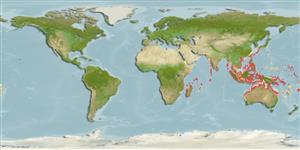
Indo-Pacific: Sri Lanka, western Australia, Indonesia and New Guinea.
Grootte / Gewicht / Leeftijd
Maturiteit: Lm ? range ? - ? cm
Max length : 13.0 cm TL mannelijk / geslacht onbekend; (Ref. 30874)
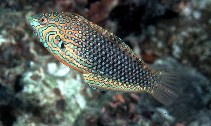
Dorsale zachte stralen (totaal) : 11; Anale zachte stralen: 11. Brown to greenish with pearly to metallic-green spots along scale rows (Ref. 48636). Females reddish anteriorly, shading to blackish posteriorly, with greenish yellow spots edged in blue and black (1 per scale) on body and similar spots and irregular bands on head. Males similar in colour to females, with no black humeral spot (Ref 9823).
Body shape (shape guide): fusiform / normal.
Inhabits lagoon and sheltered seaward reefs, in areas with mixed sand, rubble, and coral to at least 30 m. Occurs singly or in small groups (Ref. 9710).
Levenscyclus en paargedrag
Maturiteit | Voortplanting | Paaien | Eieren | Fecunditeit | Larven
Oviparous, distinct pairing during breeding (Ref. 205).
Randall, J.E., 1978. A revision of the Indo-Pacific labrid fish genus Macropharyngodon, with descriptions of five new species. Bull. Mar. Sci. 28(4):742-770. (Ref. 2694)
Status op de Rode Lijst van het IUCN (Ref. 130435: Version 2025-2 (Global))
Gevaar voor de mens
Harmless
Gebruik door de mens
Visserij: commercieel; Aquarium: Commercieel
Tools
Speciale rapporten
Download XML
Internetbronnen
Schattingen op basis van modellen
Gewenste temperatuur (Ref.
123201): 25.2 - 29.2, mean 28.6 °C (based on 2494 cells).
Fylogenetische diversiteitsindex (Ref.
82804): PD
50 = 0.5002 [Uniqueness, from 0.5 = low to 2.0 = high].
Bayesian length-weight: a=0.00977 (0.00468 - 0.02039), b=3.07 (2.90 - 3.24), in cm total length, based on LWR estimates for this (Sub)family-body shape (Ref.
93245).
Trofisch niveau (Ref.
69278): 3.5 ±0.4 se; based on size and trophs of closest relatives
Weerstandsvermogen (Ref.
120179): Hoog, minimale populatieverdubbelingstijd minder dan 15 maanden (Preliminary K or Fecundity.).
Kwetsbaarheid van de visserij (Ref.
59153): Low vulnerability (10 of 100).
🛈
Voedingsstoffen (Ref.
124155): Calcium = 94.4 [56.1, 164.7] mg/100g; Iron = 0.75 [0.43, 1.40] mg/100g; Protein = 18.5 [15.7, 20.7] %; Omega3 = 0.166 [0.104, 0.268] g/100g; Selenium = 22.6 [13.0, 42.0] μg/100g; VitaminA = 155 [48, 598] μg/100g; Zinc = 1.71 [1.15, 2.66] mg/100g (wet weight);