Environnement : milieu / zone climatique / profondeur / gamme de distribution
Écologie
marin; eau douce; saumâtre démersal; catadrome (Ref. 138274). Tropical; 22°N - 27°S
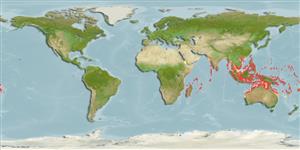
Indo-Pacific: widespread in the tropical Indian Ocean and western Pacific. Known in Australia only from streams in the Kimberley regions of northern western Australia. Africa: widespread but relatively uncommon along east and southeast African coast and Madagascar (Ref. 7248, 52193). Mozambique; Lower Zambezi River (Ref. 39494). Most easily confused with Anguilla obscura and the surest way to distinguish them is by the count of vertebrae (Ref. 9828).
Taille / Poids / Âge
Maturité: Lm ? range ? - ? cm
Max length : 123 cm TL mâle / non sexé; (Ref. 6371); common length : 65.0 cm TL mâle / non sexé; (Ref. 2871); âge max. reporté: 20 années (Ref. 48660)
Épines dorsales (Total) : 0; Rayons mous dorsaux (Total) : 240 - 245; Épines anales: 0; Rayons mous anaux: 200 - 220; Vertèbres: 105 - 115.
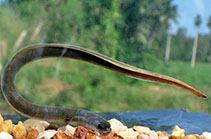
Body shape (shape guide): eel-like; Cross section: circular.
Adults inhabit freshwater streams and pools, preferring marshy habitats (Ref. 41236), in rivers and creeks, commonly over rock bottoms and in deeper pools and move as young to estuaries and seas (Ref. 12693). Seldom found in large rivers (Ref. 6028). Restricted to lowland (coastal) reaches of river systems (Ref. 7248). Adults descend to the sea to spawn (Refs. 52331, 79840). They feed on small fishes, crustaceans and mollusks. Reported to breed east of Madagascar; the south equatorial current probably carries the eel larvae and elvers towards the east coast of Africa where local coastal currents guide the elvers to suitable rivers which they invade and they stay there until sexually mature, when they return to their breeding grounds (Ref. 13337). Caught with various types of nets. Sometimes used in the aquarium trade (Ref. 6028).
Cycle de vie et comportement reproducteur
Maturité | Reproduction | Frai | Œufs | Fécondité | Larves
Kottelat, M., 2013. The fishes of the inland waters of Southeast Asia: a catalogue and core bibliography of the fishes known to occur in freshwaters, mangroves and estuaries. The Raffles Bulletin of Zoology 2013 (Suppl. 27):1-663. (Ref. 94476)
Statut dans la liste rouge de l'IUCN (Ref. 130435: Version 2025-2 (Global))
Menace pour l'homme
Harmless
Utilisations par l'homme
Pêcheries: intérêt commercial mineur
Outils
Articles particuliers
Télécharger en XML
Sources Internet
Estimations basées sur des modèles
Température préférée (Réf.
123201): 26.5 - 29.1, mean 28.3 °C (based on 1098 cells).
Indice de diversité phylogénétique (Réf.
82804): PD
50 = 0.5000 [Uniqueness, from 0.5 = low to 2.0 = high].
Bayesian length-weight: a=0.00076 (0.00037 - 0.00155), b=3.17 (3.00 - 3.34), in cm total length, based on LWR estimates for this Genus-body shape (Ref.
93245).
Niveau trophique (Réf.
69278): 3.6 ±0.50 se; based on food items.
Résilience (Réf.
120179): Faible, temps minimum de doublement de population : 4,5 à 14 années (tmax=20).
Vulnérabilité de la pêche (Ref.
59153): High to very high vulnerability (74 of 100).
🛈
Nutriments (Ref.
124155): Calcium = 58.7 [34.4, 111.3] mg/100g; Iron = 0.801 [0.472, 1.318] mg/100g; Protein = 18.8 [17.0, 20.8] %; Omega3 = 0.29 [0.14, 0.60] g/100g; Selenium = 150 [74, 289] μg/100g; VitaminA = 13.3 [3.1, 51.7] μg/100g; Zinc = 0.925 [0.650, 1.373] mg/100g (wet weight); based on
nutrient studies.