Môi trường: môi trường / vùng khí hậu / Mức độ sâu / phạm vi phân phối
Sinh thái học
biển; nước ngọt; thuộc về nước lợ gần đáy; di cư sông biển (để đẻ trứng) (Ref. 138274). Tropical; 22°N - 27°S
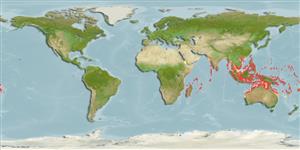
Indo-Pacific: widespread in the tropical Indian Ocean and western Pacific. Known in Australia only from streams in the Kimberley regions of northern western Australia. Africa: widespread but relatively uncommon along east and southeast African coast and Madagascar (Ref. 7248, 52193). Mozambique; Lower Zambezi River (Ref. 39494). Most easily confused with Anguilla obscura and the surest way to distinguish them is by the count of vertebrae (Ref. 9828).
Bộ gần gũi / Khối lượng (Trọng lượng) / Tuổi
Chín muồi sinh dục: Lm ? range ? - ? cm
Max length : 123 cm TL con đực/không giới tính; (Ref. 6371); common length : 65.0 cm TL con đực/không giới tính; (Ref. 2871); Tuổi cực đại được báo cáo: 20 các năm (Ref. 48660)
Các tia vây lưng cứng (tổng cộng) : 0; Các vây lưng mềm (tổng cộng) : 240 - 245; Tia cứng vây hậu môn: 0; Tia mềm vây hậu môn: 200 - 220; Động vật có xương sống: 105 - 115.
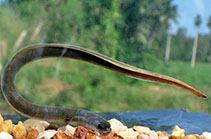
Body shape (shape guide): eel-like; Cross section: circular.
Adults inhabit freshwater streams and pools, preferring marshy habitats (Ref. 41236), in rivers and creeks, commonly over rock bottoms and in deeper pools and move as young to estuaries and seas (Ref. 12693). Seldom found in large rivers (Ref. 6028). Restricted to lowland (coastal) reaches of river systems (Ref. 7248). Adults descend to the sea to spawn (Refs. 52331, 79840). They feed on small fishes, crustaceans and mollusks. Reported to breed east of Madagascar; the south equatorial current probably carries the eel larvae and elvers towards the east coast of Africa where local coastal currents guide the elvers to suitable rivers which they invade and they stay there until sexually mature, when they return to their breeding grounds (Ref. 13337). Caught with various types of nets. Sometimes used in the aquarium trade (Ref. 6028).
Vòng đời và hành vi giao phối
Chín muồi sinh dục | Sự tái sinh sản | Đẻ trứng | Các trứng | Sự sinh sản | Ấu trùng
Kottelat, M., 2013. The fishes of the inland waters of Southeast Asia: a catalogue and core bibliography of the fishes known to occur in freshwaters, mangroves and estuaries. The Raffles Bulletin of Zoology 2013 (Suppl. 27):1-663. (Ref. 94476)
Tình trạng Sách đỏ IUCN (Ref. 130435: Version 2025-2 (Global))
Mối đe dọa đối với con người
Harmless
Sử dụng của con người
Các nghề cá: buôn bán nhỏ
Các công cụ
Báo cáo đặc biệt
Tải xuống XML
Các nguồn internet
Ước tính dựa trên mô hình
Nhiệt độ ưa thích (Tài liệu tham khảo
123201): 26.5 - 29.1, mean 28.3 °C (based on 1098 cells).
Chỉ số đa dạng phát sinh loài (Tài liệu tham khảo
82804): PD
50 = 0.5000 [Uniqueness, from 0.5 = low to 2.0 = high].
Bayesian length-weight: a=0.00076 (0.00037 - 0.00155), b=3.17 (3.00 - 3.34), in cm total length, based on LWR estimates for this Genus-body shape (Ref.
93245).
Mức dinh dưỡng (Tài liệu tham khảo
69278): 3.6 ±0.50 se; based on food items.
Thích nghi nhanh (Tài liệu tham khảo
120179): thấp, thời gian nhân đôi của chủng quần tối thiểu là 4.5 - 14 năm (tmax=20).
Sự dễ bị tổn thương của nghề đánh cá (Ref.
59153): High to very high vulnerability (74 of 100).
🛈
Chất dinh dưỡng (Ref.
124155): Calcium = 58.7 [34.4, 111.3] mg/100g; Iron = 0.801 [0.472, 1.318] mg/100g; Protein = 18.8 [17.0, 20.8] %; Omega3 = 0.29 [0.14, 0.60] g/100g; Selenium = 150 [74, 289] μg/100g; VitaminA = 13.3 [3.1, 51.7] μg/100g; Zinc = 0.925 [0.650, 1.373] mg/100g (wet weight); based on
nutrient studies.