Élasmobranches (requins et raies) (sharks and rays) >
Myliobatiformes (Stingrays) >
Myliobatidae (Eagle and manta rays)
Etymology: Myliobatis: Greek, mylo = mill + Greek, + Greek, batis,-idos = a ray (Raja sp.) (Ref. 45335).
More on author: Bleeker.
Environnement : milieu / zone climatique / profondeur / gamme de distribution
Écologie
marin démersal; profondeur 0 - 220 m (Ref. 9862). Tropical
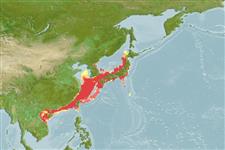
Northwest Pacific: Russia, China, South Korea and Japan.
Taille / Poids / Âge
Maturité: Lm ? range ? - ? cm
Max length : 150 cm TL mâle / non sexé; (Ref. 9862)
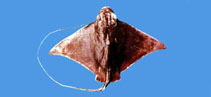
This small species (attaining about 66.5 cm DW) has the following set of characters: colour of dorsal surfaces yellowish brown, usually with variable, irregular dark blotches; tail with a very weak ventral skin fold; stinging spine(s) are relatively long (longest spine 10.3-18.6% DW); interorbital space is shallowly concave in adult males; anterior margins of pectoral fins moderately convex; cranial fontanelle (visible in dorsal view without dissection) is relatively narrow with mostly straight lateral margins; claspers of adult males 6.6-10.2% DW; predorsal length 66.6-78.8% DW; each jaw with 7 rows of teeth, with a broad median row flanked by three smaller rows on each side; pectoral-fin radials 79-85 (excluding rostral propterygial radials anterior of the eyes); total vertebral centra (including synarcual) 115-124; males mature by 42.9 cm DW (Ref. 132213).
Cross section: flattened.
Found from the intertidal to the uppermost continental slope (Ref. 9862, 11230). A carnivore feeding on benthic animals. Ovoviviparous (Ref. 50449). Males and females ranged in size from 24.5-61.9 and 21.4-65.6 cm DW, respectively. Five males between 42.9 and 61.9 cm DW were found to be mature and a 41.0 cm DW male was adolescent, while 18 males between 24.5 and 32.3 cm DW were immature. A female of 65.6 cm DW was found pregnant. A reported abnormal female specimen was 66.5 cm DW and weighed 5.5 kg. The largest male examined was 61.9 cm DW had a total length of 125.7 cm (Ref. 132213).
Cycle de vie et comportement reproducteur
Maturité | Reproduction | Frai | Œufs | Fécondité | Larves
Exhibit ovoviparity (aplacental viviparity), with embryos feeding initially on yolk, then receiving additional nourishment from the mother by indirect absorption of uterine fluid enriched with mucus, fat or protein through specialised structures (Ref. 50449).
White, W.T., J. Kawauchi, S. Corrigan, E. Rochel and G.J.P. Naylor, 2015. Redescription of the eagle rays Myliobatis hamlyni Ogilby, 1911 and M. tobijei Bleeker, 1854 (Myliobatiformes: Myliobatidae) from the east Indo-West Pacific. Zootaxa 3948(3):521-548. (Ref. 132213)
Statut dans la liste rouge de l'IUCN (Ref. 130435: Version 2025-2 (Global))
Menace pour l'homme
Traumatogenic
Utilisations par l'homme
Pêcheries: intérêt commercial mineur; pêche sportive: oui
Outils
Articles particuliers
Télécharger en XML
Sources Internet
Estimations basées sur des modèles
Température préférée (Réf.
123201): 12.8 - 24.7, mean 20.3 °C (based on 176 cells).
Indice de diversité phylogénétique (Réf.
82804): PD
50 = 0.5002 [Uniqueness, from 0.5 = low to 2.0 = high].
Bayesian length-weight: a=0.00389 (0.00124 - 0.01219), b=3.08 (2.83 - 3.33), in cm total length, based on LWR estimates for this (Sub)family-body shape (Ref.
93245).
Niveau trophique (Réf.
69278): 3.5 ±0.37 se; based on food items.
Résilience (Réf.
120179): Faible, temps minimum de doublement de population : 4,5 à 14 années (Fec assumed to be <100).
Vulnérabilité de la pêche (Ref.
59153): Very high vulnerability (90 of 100).
🛈